Zebra Mbuna
Maylandia zebra
Cichlidae
About
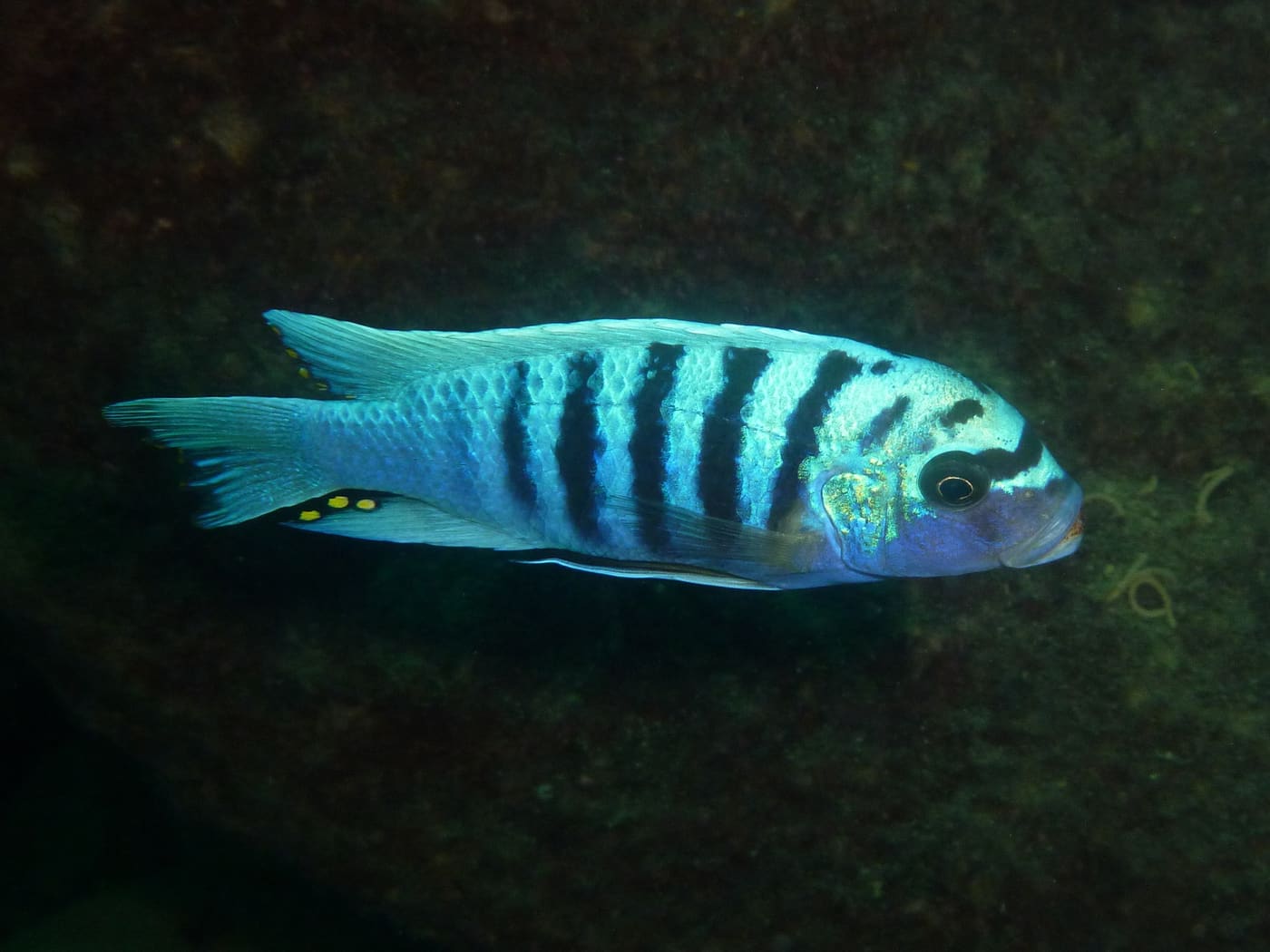
The archetypal mbuna of Lake Malawi, found along rocky shores, reefs and island drop-offs where males hold boulder territories and rasp algae from stone. Wild-type males are pale blue crossed by dark vertical bars; decades of line breeding have added red, white and blotched OB (orange-blotch) morphs that look like completely different fish. Behaviourally it is one of the pushier mbuna: a restless, quarrelsome rock cichlid that chases rivals constantly and is not a community fish in any normal sense.
Care
Give it at least 200 litres on a 120 cm footprint, stacked rockwork with caves and crevices over sand, bright light to grow grazing algae, hard alkaline water (pH around 8, GH 10-25 dH) and heavy filtration with generous water changes. Keep one male to three or more females so his attention is spread; never mix with peacocks (Aulonocara) or gentle community fish. A tight lid is essential.
Diet
Feed a vegetable staple - spirulina flake or pellet, blanched spinach, nori - every day, and treat bloodworm or Artemia as a rare extra. Protein-heavy feeding triggers Malawi bloat in this grazer, and never offer beefheart or mammal meat. Several small feeds beat one large one, since the species fattens quickly.
Tankmate compatibility
Possible with care (147)
Avoid (124)
Computed by the AquaSage engine for a spacious reference tank — always check the full verdict for your exact setup in the calculator.
Telling males from females
What works for this species, most reliable first.
- VentingStrong · only on a mature fish, easiest when she is in breeding condition
The method breeders use when the answer has to be right. Hold the fish upside down in a wet hand or soft net and look at the two openings ahead of the anal fin. The forward one is the anus; the one behind it is what you are reading.
- Egg spotsA hint only · from about 6 months
The yellow or orange ocelli on the anal fin of Malawi cichlids, traditionally explained as a lure that draws the female into mouthing them, fertilising the eggs she is already holding.
- Adult sizeA hint only · only across animals of the same age
In many cichlids, catfish and loaches one sex simply grows larger — usually the male, though there are well-known reversals.
Also in these lists
Frequently asked questions
- What tank size does a Zebra Mbuna need?
- A Zebra Mbuna needs an aquarium of at least 200 litres (52.8 US gallons) with a footprint at least 120 cm (47.2 in) long — for this species, swimming length matters as much as raw volume.
- What water parameters does a Zebra Mbuna need?
- Zebra Mbuna does best at 22–28 °C (71.6–82.4 °F), pH 7.5–8.8 and a general hardness of 10–25 °dGH.
- What group size does a Zebra Mbuna need?
- Zebra Mbuna is a social species — keep a group of at least 4 so natural behaviour emerges and stress stays low.
- Is the Zebra Mbuna suitable for beginners?
- Zebra Mbuna sits in the middle of the difficulty scale — manageable for a careful beginner who has done the reading, but it has specific needs worth researching first.