Even-spotted Synodontis
Synodontis petricola
Mochokidae
About
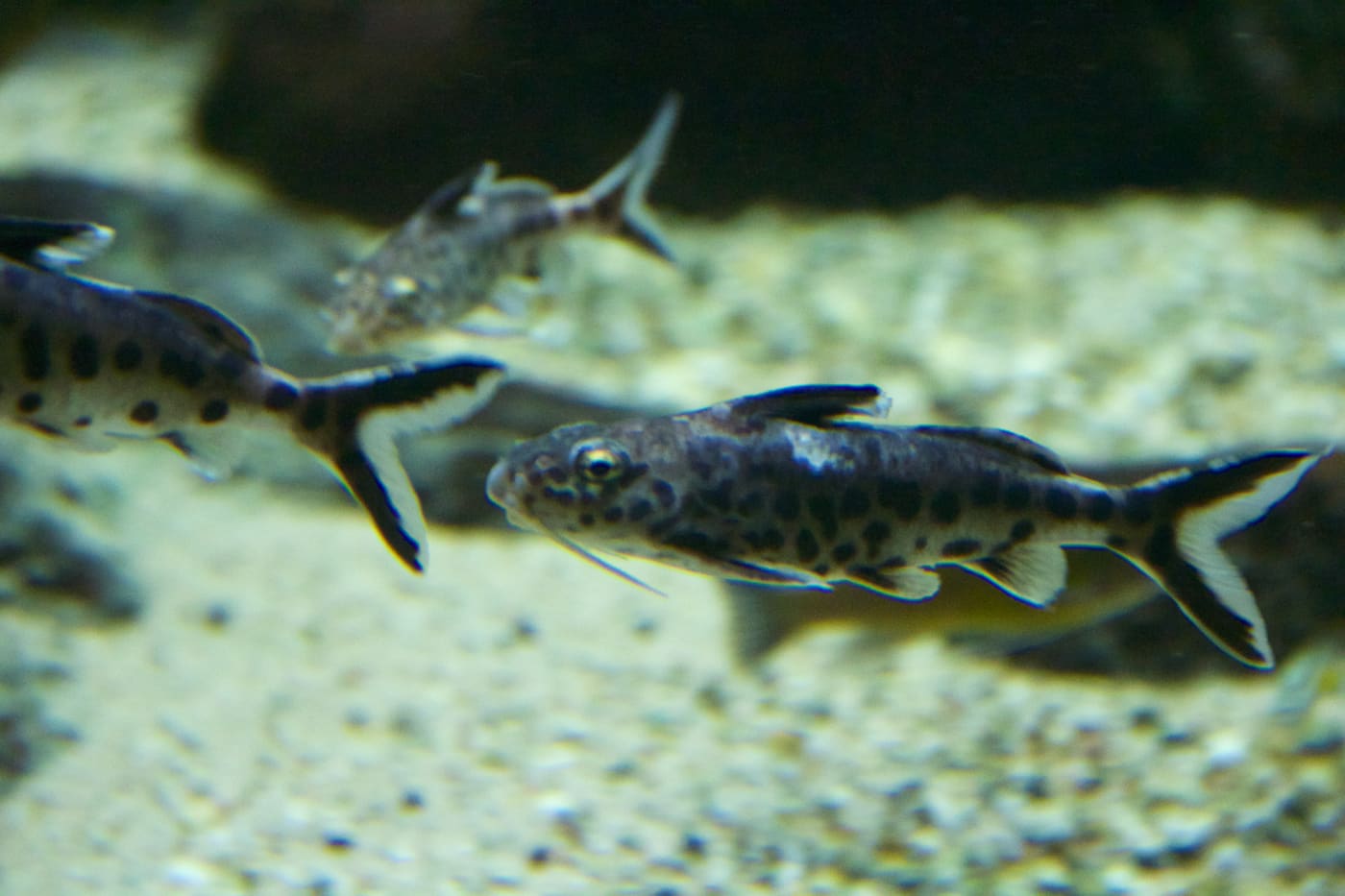
A dwarf Synodontis endemic to the rocky shorelines of Lake Tanganyika. Most aquarium fish settle around 10-11 cm, but measured specimens reach 11.5 cm standard length and 13.5 cm total length, so plan for a 13 cm adult rather than a 10 cm one. The copper-brown body carries bold black blotches, every rayed fin has a dark triangle at its base, and the dorsal and pectoral spines end in a crisp white tip. It is unusually sociable for the genus: a lone fish disappears into the rockwork and is rarely seen, while a group of four to six patrols the open water confidently, often gliding belly-up beneath ledges. One naming point matters more than any care number here. For nearly twenty years the trade split this fish in two, selling the smaller, window-marked individuals as Synodontis lucipinnis, a species described in 2006 and separated from S. petricola by a tiny axillary pore behind the pectoral spine. A 2024 revision of the Lake Tanganyika Synodontis (Englmaier et al., Zoological Journal of the Linnean Society) re-examined that material both genetically and morphologically and sank S. lucipinnis as a junior synonym of S. petricola: the pore and the pale fin windows fall inside the variation of one species. Both names on a shop tank therefore point at the same fish, and the spread of adult sizes you may meet, roughly 8 to 13 cm, is simply that variation.
Care
Give it hard, alkaline, well-oxygenated water with moderate flow, a sand bottom that will not shred the barbels, and stacked rock forming caves it can wedge into. A tight-fitting lid is essential: these catfish climb and jump. Keep four to six, never one, and expect them to stay hidden if the group is too small. They suit a Tanganyikan cichlid community perfectly, and also work with hard-water rainbowfish or livebearers, but anything under about 3 cm counts as food. Dim lighting or plenty of shade brings them out into the open.
Diet
Easy to feed and enthusiastic about almost anything that sinks. Sinking pellets or wafers form the staple; supplement with frozen bloodworm, brine shrimp and mysis, and give vegetable matter such as blanched courgette or shelled peas, which they scrape at with their lower teeth. They are prone to overeating, so feed small amounts rather than one large meal.
Tankmate compatibility
Gets along with (25)
Possible with care (122)
Avoid (124)
Computed by the AquaSage engine for a spacious reference tank — always check the full verdict for your exact setup in the calculator.
Telling males from females
What works for this species, most reliable first.
- Adult sizeA hint only · only across animals of the same age
In many cichlids, catfish and loaches one sex simply grows larger — usually the male, though there are well-known reversals.
Also in these lists
Frequently asked questions
- What tank size does a Even-spotted Synodontis need?
- A Even-spotted Synodontis needs an aquarium of at least 120 litres (31.7 US gallons) with a footprint at least 90 cm (35.4 in) long — for this species, swimming length matters as much as raw volume.
- What water parameters does a Even-spotted Synodontis need?
- Even-spotted Synodontis does best at 23–28 °C (73.4–82.4 °F), pH 7.5–9 and a general hardness of 8–30 °dGH.
- What group size does a Even-spotted Synodontis need?
- Even-spotted Synodontis is a social species — keep a group of at least 4 so natural behaviour emerges and stress stays low.
- Is the Even-spotted Synodontis suitable for beginners?
- Yes — Even-spotted Synodontis is one of the easier species to keep and forgives typical first-tank mistakes, as long as the aquarium is cycled and maintained.
Sources
- Synodontis petricola (Dwarf Lake Synodontis, False Cuckoo Synodontis) - Seriously Fish
- Pygmy Leopard Catfish - Synodontis petricola Fish Profile & Care Guide - Aquadiction
- Catfish Corner: Lake Tanganyikan Synodontis - the Revision (Lee Finley) - Tropical Fish Hobbyist
- Synodontis petricola - Wikipedia
- Visually comparing Synodontis petricola & S. lucipinnis - PlanetCatfish (Shane's World)
- Revised taxonomy of Synodontis catfishes (Siluriformes: Mochokidae) from the Lake Tanganyika basin reveals lower species diversity than expected - Englmaier et al., Zoological Journal of the Linnean Society 202(3), 2024