Bumblebee Cichlid
Pseudotropheus crabro
Cichlidae
About
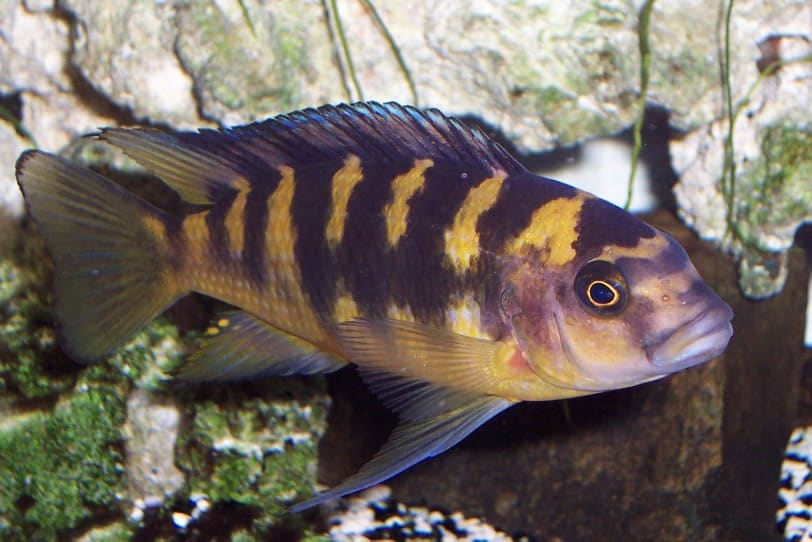
A Lake Malawi mbuna from the deeper rocky reefs, sheltering in large caves and around boulders alongside Bagrus catfish. Adults usually reach about 13 cm — some aquarium sources report considerably larger males — and wear eight or nine dark transverse bars over a yellow body. The striking part is that the fish can drop to near-black within seconds and hold that colour at will, which is why buyers regularly conclude their fish was swapped for another species. In the wild it earns its place picking parasites off Bagrus meridionalis, then switches to the dark suit to raid the same catfish's eggs unrecognised. In the aquarium it is a pushy, territorial mbuna that claims a cave and defends it hard.
Care
Hard, alkaline water (pH 7.6-8.8) and a long rocky tank with many caves. Keep one male with three or more females: a lone female is harassed to death, and a dominant male will kill rival males. Sand substrate, strong filtration and frequent water changes, because the bioload is heavy. Stack rock directly on the base glass so digging cannot topple it. 250 L over a 120 cm footprint is the honest minimum; 150 cm is better if your male grows past 15 cm.
Diet
An easy omnivore in captivity despite its exotic wild diet. Feed a Malawi-appropriate staple with real vegetable content — spirulina flake or a seaweed-based pellet — and rotate in frozen mysis, daphnia, cyclops or krill a few times a week. Blanched vegetables are a useful occasional addition. Avoid heavy loads of mammalian meat or constant bloodworm. It will eat fry and any fish small enough to fit in its mouth.
Tankmate compatibility
Possible with care (153)
Avoid (118)
Computed by the AquaSage engine for a spacious reference tank — always check the full verdict for your exact setup in the calculator.
Telling males from females
What works for this species, most reliable first.
- VentingStrong · only on a mature fish, easiest when she is in breeding condition
The method breeders use when the answer has to be right. Hold the fish upside down in a wet hand or soft net and look at the two openings ahead of the anal fin. The forward one is the anus; the one behind it is what you are reading.
- Egg spotsA hint only · from about 6 months
The yellow or orange ocelli on the anal fin of Malawi cichlids, traditionally explained as a lure that draws the female into mouthing them, fertilising the eggs she is already holding.
- Adult sizeA hint only · only across animals of the same age
In many cichlids, catfish and loaches one sex simply grows larger — usually the male, though there are well-known reversals.
Also in these lists
Frequently asked questions
- What tank size does a Bumblebee Cichlid need?
- A Bumblebee Cichlid needs an aquarium of at least 250 litres (66 US gallons) with a footprint at least 120 cm (47.2 in) long — for this species, swimming length matters as much as raw volume.
- What water parameters does a Bumblebee Cichlid need?
- Bumblebee Cichlid does best at 24–28 °C (75.2–82.4 °F), pH 7.6–8.8 and a general hardness of 10–25 °dGH.
- What group size does a Bumblebee Cichlid need?
- Bumblebee Cichlid is a social species — keep a group of at least 4 so natural behaviour emerges and stress stays low.
- Is the Bumblebee Cichlid suitable for beginners?
- Bumblebee Cichlid is a demanding species best attempted with some experience — it needs stable, closely watched conditions to thrive.