AquaSage
Species library

Wrestling Halfbeak

Dermogenys pusilla

Zenarchopteridae
FishDifficulty: ●●●○○Data: verified
Wrestling Halfbeak — Dermogenys pusilla
📷 Ahsan_al_hidayat (Wikimedia Commons) · CC BY-SA 3.0 · resized · Wikimedia Commons

About

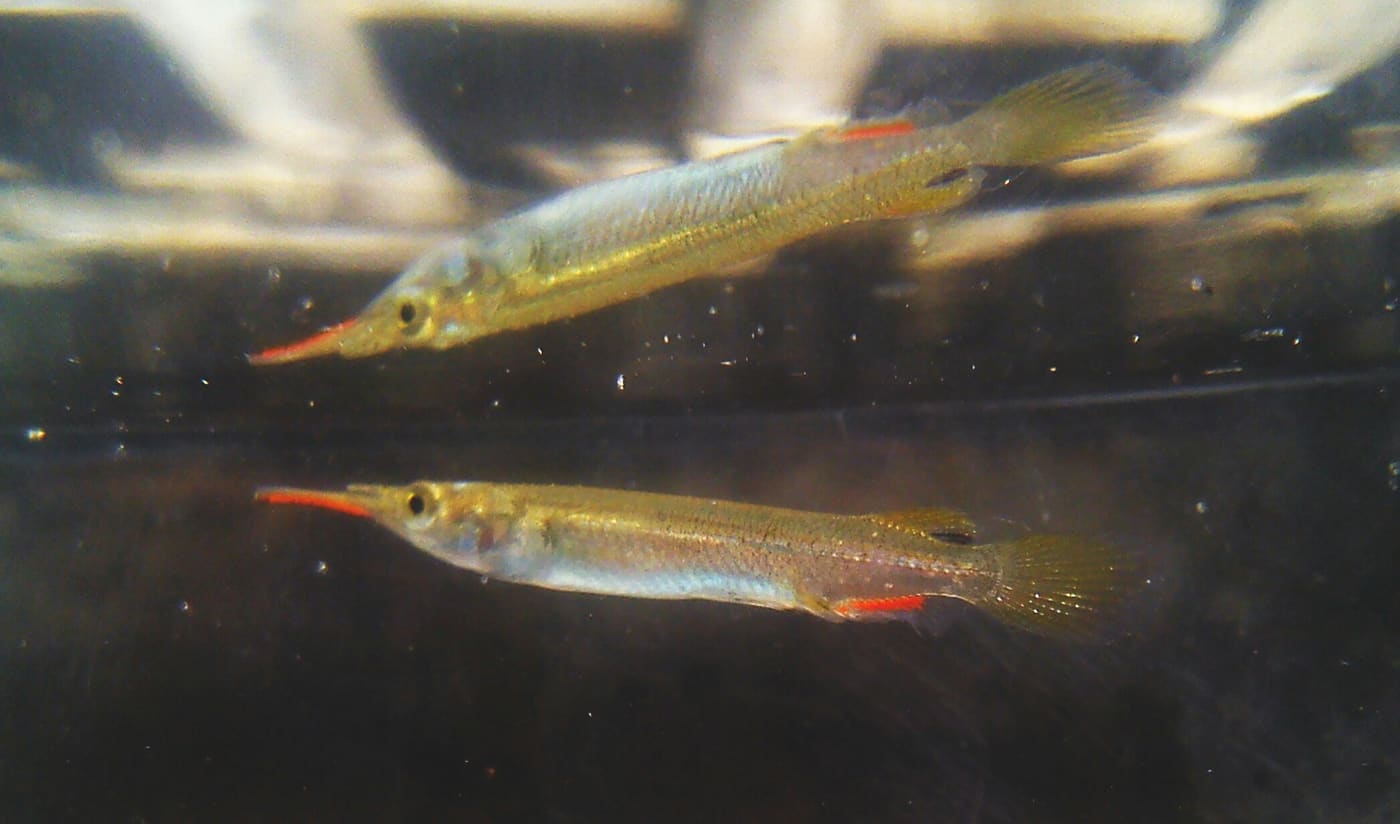
A slender livebearing surface specialist from the sluggish canals, drainage ditches, flooded fields and weedy ponds of South-East Asia, recorded from Thailand and Malaysia through to Java, and drifting into brackish mangrove fringes in the wet season. The fixed lower jaw juts forward like a needle beneath a short, hinged upper jaw, and the silvery body hangs almost motionless just under the film until an insect lands. Males are the smaller sex, carry a red or yellow flash in the dorsal fin, and settle disputes by locking beaks and wrestling — the behaviour that gave the fish its trade name.

Care

Give it a long, tightly covered tank with a large open surface, dense planting and floating cover around the edges, and almost no current — surface area matters far more than depth. Water should be hard, near-neutral to slightly alkaline and above all stable: it reacts badly to deteriorating quality and to sudden swings in temperature or chemistry, so use small, frequent water changes rather than large ones. Keep one male with three or more females, or several males in a tank long enough for a loser to retreat. Never house it with boisterous, fast or larger fish; a chased or startled halfbeak bolts into the glass and can break its beak, and it jumps hard enough that a tight lid is mandatory.

Diet

Feed only at the surface, in small amounts twice a day. Gut-loaded fruit flies are the ideal staple; rotate in frozen or live mosquito larvae, daphnia, cyclops and bloodworm. Floating micro-pellets or crushed flake may be refused at first but are usually accepted over time — offer them, but do not make them the whole diet.

Tankmate compatibility

Gets along with (37)

Possible with care (181)

Acei CichlidAfrican Butterfly CichlidAfrican ButterflyfishAgassiz's CoryAgassiz's Dwarf CichlidAmano ShrimpAngelfishAuratus CichlidBanjo CatfishBlack Neon TetraBlack Phantom TetraBlack Ruby BarbBlack Skirt TetraBlackline RasboraBleeding Heart TetraBlue AcaraBlue Dolphin CichlidBlue Tiger ShrimpBlue Velvet ShrimpBolivian RamBorleyi (Redfin Hap)Borneo SuckerBrevis Shell DwellerBrichard's TeleogrammaBrichardi (Fairy Cichlid)Bristlenose PlecoBronze CorydorasBuenos Aires TetraBuffalohead CichlidBumblebee CichlidButterfly Hillstream LoachCalvus CichlidCelestial Pearl DanioCheckered BarbCherry BarbCherry ShrimpChocolate CichlidClown KillifishClown PlecoCobalt Blue ZebraCockatoo Dwarf CichlidColombian Ramshorn SnailCompressiceps CichlidCongo Dwarf CichlidCongo TetraConvict CichlidCuckoo CatfishCylindricus CichlidCyprichromisDemasoni CichlidDenison BarbDiamond TetraDiscusDoctor FishDogtooth CichlidDojo (Weather) LoachDuboisi TropheusDwarf Chain LoachDwarf Flag CichlidDwarf GouramiDwarf Orange CrayfishDwarf Petricola CatfishElectric Blue AhliElectric Yellow LabElephantnose FishEllioti CichlidElongate MbunaEmperor TetraEven-spotted SynodontisFeatherfin SqueakerFestivum (Flag Cichlid)Firemouth CichlidFive-bar CichlidFlame TetraFreshwater ClamGerman Blue RamGlass CatfishGlowlight DanioGlowlight TetraGoby CichlidGold BarbGolden Dwarf CichlidGolden JulieGolden PencilfishGolden TetraGolden Wonder KillifishGreen DiscusHarlequin RasboraHead-and-Tail-Light TetraHoney GouramiHongi CichlidJapanese Trapdoor SnailJewel CichlidJohanni CichlidJulii CoryKenyi CichlidKeyhole CichlidKissing GouramiKribensisKuhli LoachLambchop RasboraLeast KillifishLemon CichlidLemon TetraLeopard DanioLittle CorydorasMacmasteri Dwarf CichlidMaingano CichlidMarble HatchetfishMarlieri CichlidMasked JulieMedaka RicefishMollyMoonlight GouramiMultifasciatus Shell DwellerMystery SnailNeon TetraOcellatus Shell DwellerOdessa BarbOtocinclusPanda CorydorasParadise FishParaguay EartheaterPeaceful BettaPeacock CichlidPearl DanioPearl GouramiPeppered CorydorasPictus CatfishPlatyPolka Dot LoachPort CichlidPowder Blue CichlidPurple Emperor TetraPygmy CorydorasRainbow CichlidRamshorn SnailRed EmpressRed Whiptail CatfishRed Zebra CichlidRedhead CichlidRegan's JulieReticulated Hillstream LoachRosy BarbRosy TetraRubber Lip PlecoRummynose TetraRusty CichlidSailfin MollySalt and Pepper CorySalvini CichlidSand-sifting XenotilapiaSaulosi CichlidScarlet BadisScissortail RasboraSerpae TetraSeverumSilver MoonySimilis Shell DwellerSkunk CorySparkling GouramiSpotted HoploStar SapphireSterbai CorydorasStriped KribensisSunshine PeacockSveni EartheaterTaiwan Reef CichlidThai Micro CrabThick-lipped GouramiThreadfin AcaraThreadfin PetrochromisThreadfin RainbowfishTropheusUaru (Triangle Cichlid)Umbrella Dwarf CichlidWhite Cloud Mountain MinnowYoyo LoachZebra DanioZebra MbunaZebra Pleco

Avoid (53)

Computed by the AquaSage engine for a spacious reference tank — always check the full verdict for your exact setup in the calculator.

Telling males from females

What works for this species, most reliable first.

  • The gonopodiumDefinitive · from about 4 weeks old

    Look at the anal fin, underneath and just behind the belly. In females it stays a broad triangular fan. In males it narrows into a rod and angles forward — that rod is the gonopodium, a rebuilt fin rather than an organ that appears from nowhere.

All the methods, with diagrams

Also in these lists

Frequently asked questions

What tank size does a Wrestling Halfbeak need?
A Wrestling Halfbeak needs an aquarium of at least 80 litres (21.1 US gallons) with a footprint at least 80 cm (31.5 in) long — for this species, swimming length matters as much as raw volume.
What water parameters does a Wrestling Halfbeak need?
Wrestling Halfbeak does best at 23–29 °C (73.4–84.2 °F), pH 6.5–8.2 and a general hardness of 8–20 °dGH.
What group size does a Wrestling Halfbeak need?
Wrestling Halfbeak is a social species — keep a group of at least 4 so natural behaviour emerges and stress stays low.
Is the Wrestling Halfbeak suitable for beginners?
Wrestling Halfbeak sits in the middle of the difficulty scale — manageable for a careful beginner who has done the reading, but it has specific needs worth researching first.

Sources

Water & tank

Temperature23–29°C
Optimal temp.24–28°C
pH6.5–8.2
Hardness (GH)8–20°d
Carbonate (KH)5–15°d
Adult size7 cm
Min. volume≥ 80 L
Min. tank length≥ 80 cm
Group size≥ 4
Swimming zoneTop
TemperamentPeaceful
Water typeBrackish-tolerant
FlowLow
Lifespan~3 yrs
Try in the calculator