Glowlight Danio
Danio choprae
Cyprinidae
About
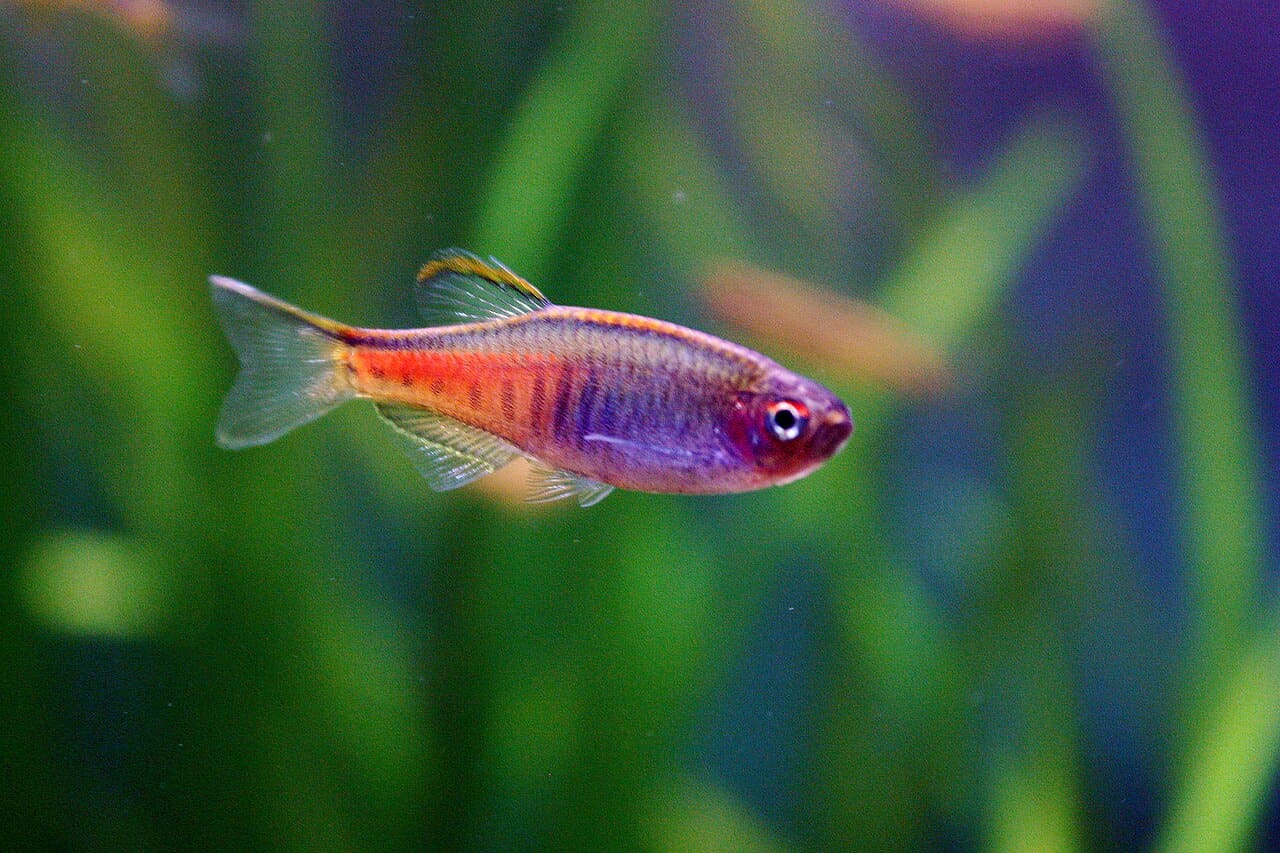
The glowlight danio is a 3 cm cyprinid endemic to small rocky streams of the Mogaung Chaung system near Kamaing and Namma in Kachin State, northern Myanmar. A pearlescent blue flank stripe overlaid with a row of orange and turquoise bars gives it its name, and it is the more sedate, mid-water alternative to the frantic zebra danio. Those northern hill streams run cool, which is the detail most keepers miss: this is a subtropical fish, not a 27 °C tropical community filler.
Care
Keep 8-10 in a long tank at a subtropical 20-24 °C with moderate flow and a tight lid. Males spar inside the group, so the shoal has to be large enough to spread the pressure around.
Diet
Insectivore in the wild; takes any quality dry food but shows best colour on frozen or live bloodworm, daphnia and brine shrimp.
Tankmate compatibility
Gets along with (44)
Possible with care (169)
Avoid (58)
Computed by the AquaSage engine for a spacious reference tank — always check the full verdict for your exact setup in the calculator.
Telling males from females
What works for this species, most reliable first.
- Belly depthA hint only · only on well-fed adults, and only as a comparison
For most tetras, barbs and rasboras this is all there is: a conditioned female is deeper through the belly than a male of the same length.
Also in these lists
Frequently asked questions
- What tank size does a Glowlight Danio need?
- A Glowlight Danio needs an aquarium of at least 70 litres (18.5 US gallons) with a footprint at least 80 cm (31.5 in) long — for this species, swimming length matters as much as raw volume.
- What water parameters does a Glowlight Danio need?
- Glowlight Danio does best at 16–26 °C (60.8–78.8 °F), pH 6–8 and a general hardness of 1–12 °dGH.
- What group size does a Glowlight Danio need?
- Glowlight Danio is a social species — keep a group of at least 8 so natural behaviour emerges and stress stays low.
- Is the Glowlight Danio suitable for beginners?
- Yes — Glowlight Danio is one of the easier species to keep and forgives typical first-tank mistakes, as long as the aquarium is cycled and maintained.