Figure-8 Puffer
Dichotomyctere ocellatus
Tetraodontidae
About
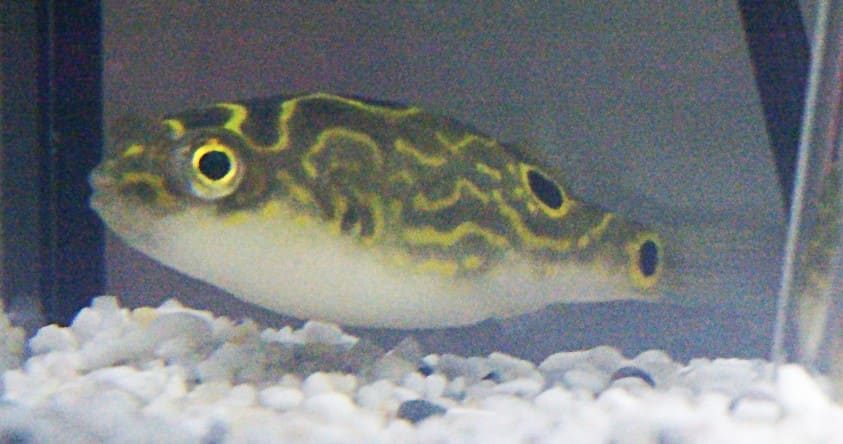
The figure-8 puffer is a small, intelligent brackish-water pufferfish from the estuaries and tidal streams of Southeast Asia, named for the looping figure-eight and eyespot markings across its olive-and-gold back. Reaching around 8 cm, it is curious and interactive but also a nippy, semi-aggressive predator that is best kept singly or in a species tank. Unlike full-marine puffers it thrives long-term in low-end brackish water rather than soft freshwater, and it needs a steady supply of hard-shelled snails to keep its ever-growing teeth in check.
Care
Keep one to a tank (or a species-only setup) in low-end brackish water, SG about 1.005-1.008, that is warm, hard and alkaline. Not a soft freshwater community fish — it nips fins and preys on tankmates.
Diet
Obligate hard-shelled carnivore; offer snails, clams, mussels and shell-on shrimp several times weekly to wear down the beak, supplemented with frozen bloodworm and other meaty foods. It will not touch dry food.
Tankmate compatibility
Gets along with (11)
Possible with care (172)
Avoid (88)
Computed by the AquaSage engine for a spacious reference tank — always check the full verdict for your exact setup in the calculator.
Telling males from females
What works for this species, most reliable first.
- Adult sizeA hint only · only across animals of the same age
In many cichlids, catfish and loaches one sex simply grows larger — usually the male, though there are well-known reversals.
Also in these lists
Frequently asked questions
- What tank size does a Figure-8 Puffer need?
- A Figure-8 Puffer needs an aquarium of at least 75 litres (19.8 US gallons) with a footprint at least 60 cm (23.6 in) long — for this species, swimming length matters as much as raw volume.
- What water parameters does a Figure-8 Puffer need?
- Figure-8 Puffer does best at 22–28 °C (71.6–82.4 °F), pH 7–8.5 and a general hardness of 8–25 °dGH.
- Is the Figure-8 Puffer suitable for beginners?
- Figure-8 Puffer is a demanding species best attempted with some experience — it needs stable, closely watched conditions to thrive.