Polka Dot Loach
Botia kubotai
Botiidae
About
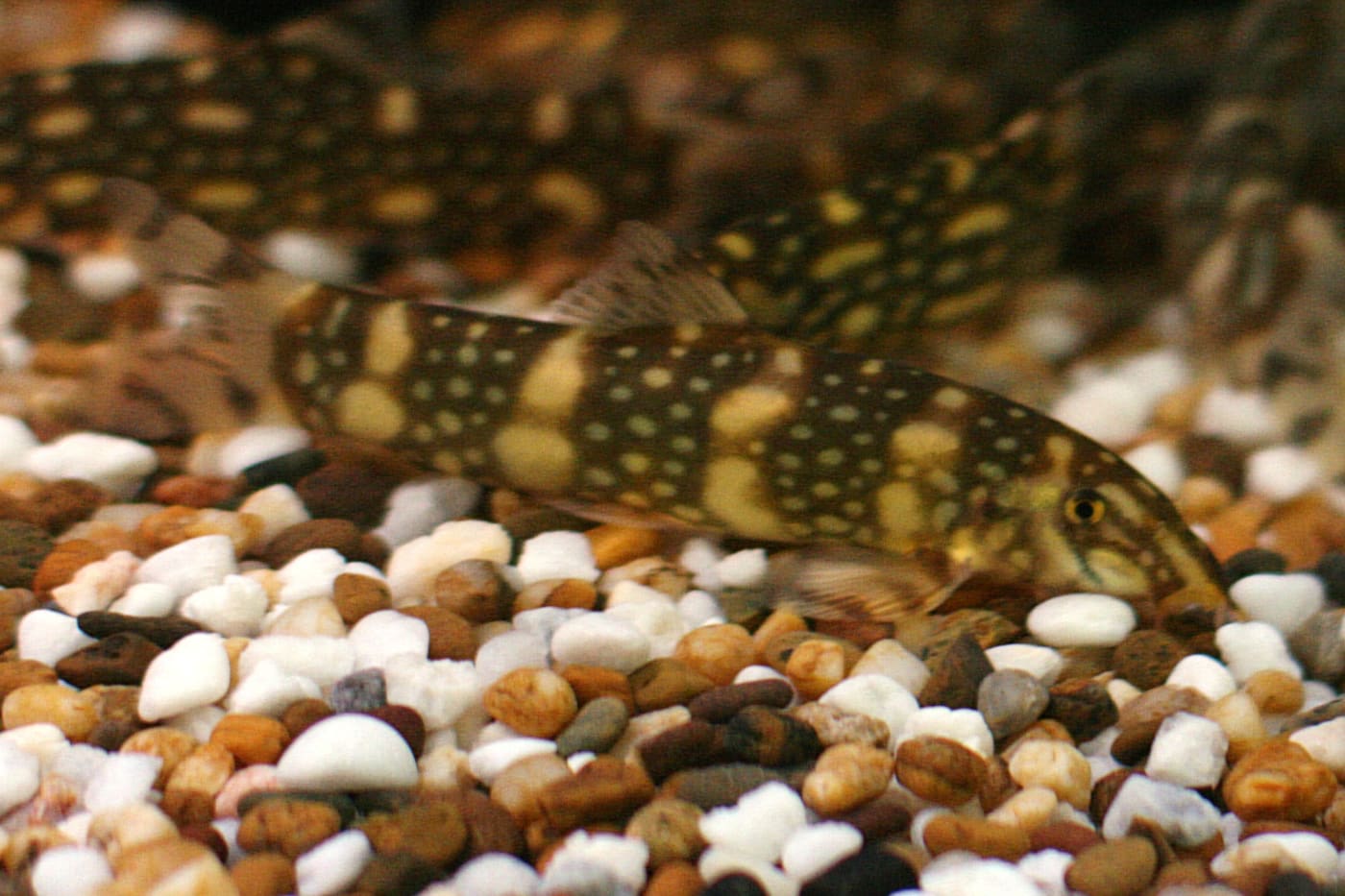
The polka dot loach comes from forest-shaded headwaters of the Salween basin on the Myanmar-Thailand border, where it works over mixed sand and rock among driftwood and leaf litter. Juveniles wear crisp black bars and stripes broken by pale yellow blotches; as the fish matures that pattern fragments into an intricate marbled mosaic, so no two adults look quite alike. Reaching roughly 15 cm, it is a busy, inquisitive bottom-dweller that clicks audibly when excited, wedges itself into crevices at odd angles to rest, and lives by a strict pecking order — a lone specimen turns withdrawn or starts bullying its tankmates, while a group of five or more settles down and swims openly.
Care
Keep a shoal of at least five (ten is better) in a mature, spotlessly clean aquarium of around 200 litres with a base no shorter than 120 cm. Give soft sand or very fine gravel to protect the barbels, smooth water-worn rocks, driftwood roots and plenty of caves and crevices, moderate flow with strong oxygenation, and 30-50% weekly water changes — botiids will not tolerate accumulating organic waste and must never go into an immature tank. Fit a tight lid because they jump, seal any gap that could trap a fish, and skip slow, long-finned tankmates whose trailing fins get nipped.
Diet
Offer sinking pellets, wafers and tablets daily, backed by frequent frozen or live bloodworm, Tubifex, brine shrimp and Daphnia, with blanched cucumber or courgette now and then. Expect it to eat every snail it can find, and dose medications carefully — like most loaches it has reduced scaling and is sensitive to overdosing.
Tankmate compatibility
Gets along with (33)
Possible with care (152)
Avoid (86)
Computed by the AquaSage engine for a spacious reference tank — always check the full verdict for your exact setup in the calculator.
Telling males from females
What works for this species, most reliable first.
- Adult sizeA hint only · only across animals of the same age
In many cichlids, catfish and loaches one sex simply grows larger — usually the male, though there are well-known reversals.
Also in these lists
Frequently asked questions
- What tank size does a Polka Dot Loach need?
- A Polka Dot Loach needs an aquarium of at least 200 litres (52.8 US gallons) with a footprint at least 120 cm (47.2 in) long — for this species, swimming length matters as much as raw volume.
- What water parameters does a Polka Dot Loach need?
- Polka Dot Loach does best at 22–28 °C (71.6–82.4 °F), pH 6–7.5 and a general hardness of 2–12 °dGH.
- What group size does a Polka Dot Loach need?
- Polka Dot Loach is a social species — keep a group of at least 5 so natural behaviour emerges and stress stays low.
- Is the Polka Dot Loach suitable for beginners?
- Polka Dot Loach sits in the middle of the difficulty scale — manageable for a careful beginner who has done the reading, but it has specific needs worth researching first.