Chinese Algae Eater
Gyrinocheilus aymonieri
Gyrinocheilidae
About
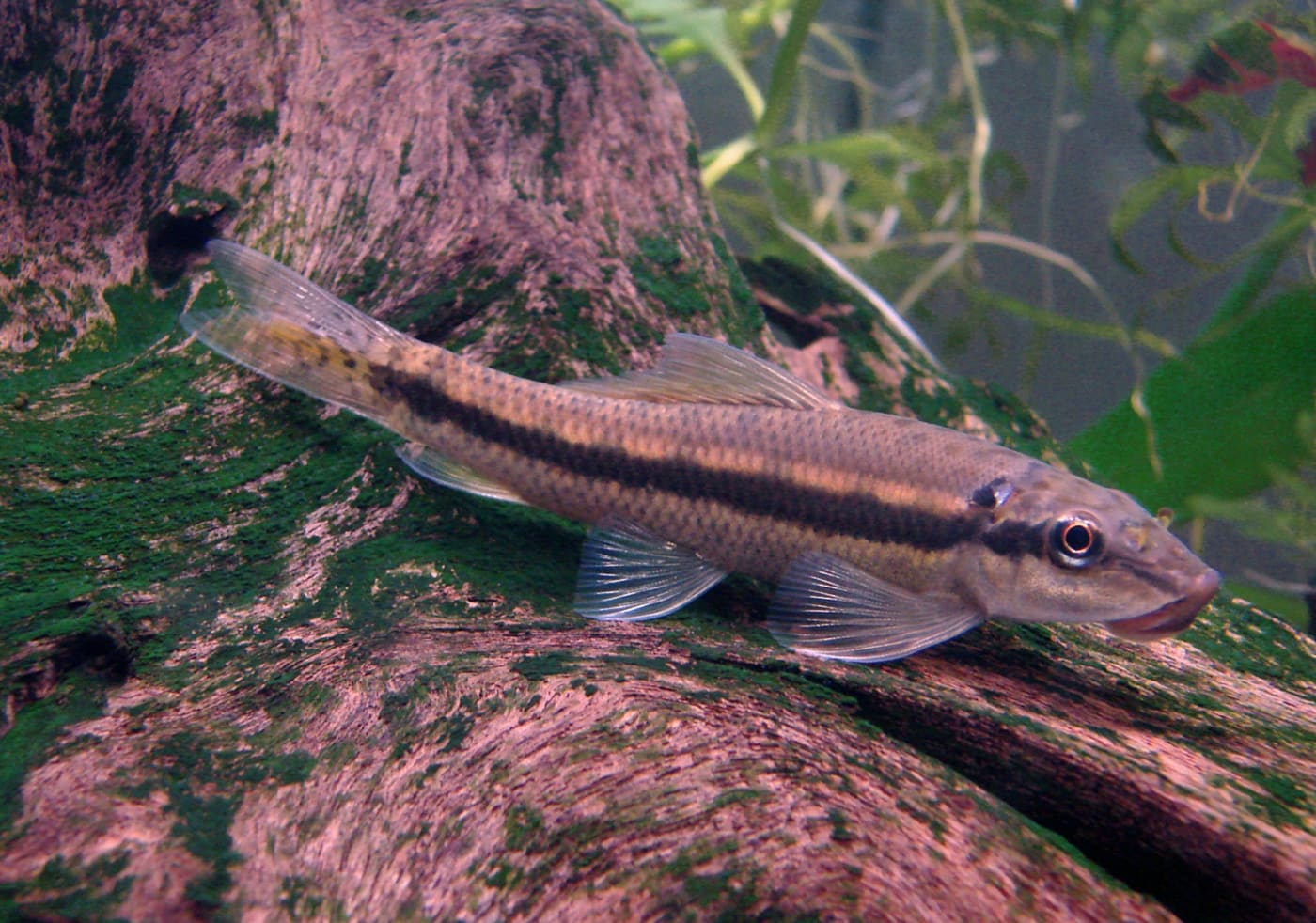
Despite the trade name, the Chinese algae eater comes from the Mekong, Chao Phraya and Mae Klong basins of Thailand, Laos, Cambodia and Vietnam, not China. It is an elongated, brownish fish with a dark, bumpy lateral stripe and a powerful sucker mouth used to cling to rocks in flowing water; gold and albino strains are common in shops. Sold small as an industrious algae grazer, it grows to around 28 cm, becomes territorial with age and may latch onto the flanks of slow, flat-bodied fish such as angelfish or discus to rasp their slime coat, so it is largely unsuitable for a general community tank.
Care
Needs a large (300 L+, 150 cm long), well-oxygenated tank with current, rockwork and a tight lid; keep singly with fast, robust tankmates and never with angelfish, discus or other slow flat-bodied fish.
Diet
Juveniles graze algae and biofilm effectively; adults eat far less algae, so offer algae wafers, blanched vegetables (courgette, spinach, peas) and occasional frozen foods like bloodworm or Daphnia.
Tankmate compatibility
Gets along with (75)
Possible with care (158)
Avoid (38)
Computed by the AquaSage engine for a spacious reference tank — always check the full verdict for your exact setup in the calculator.
Telling males from females
There is no reliable way to sex this species by eye. That is the honest answer, not a gap in our data.
All the methods, with diagramsAlso in these lists
Frequently asked questions
- What tank size does a Chinese Algae Eater need?
- A Chinese Algae Eater needs an aquarium of at least 300 litres (79.3 US gallons) with a footprint at least 150 cm (59.1 in) long — for this species, swimming length matters as much as raw volume.
- What water parameters does a Chinese Algae Eater need?
- Chinese Algae Eater does best at 20–28 °C (68–82.4 °F), pH 6–8 and a general hardness of 2–20 °dGH.
- Is the Chinese Algae Eater suitable for beginners?
- Yes — Chinese Algae Eater is one of the easier species to keep and forgives typical first-tank mistakes, as long as the aquarium is cycled and maintained.