Dwarf Petricola Catfish
Synodontis lucipinnis
Mochokidae
About
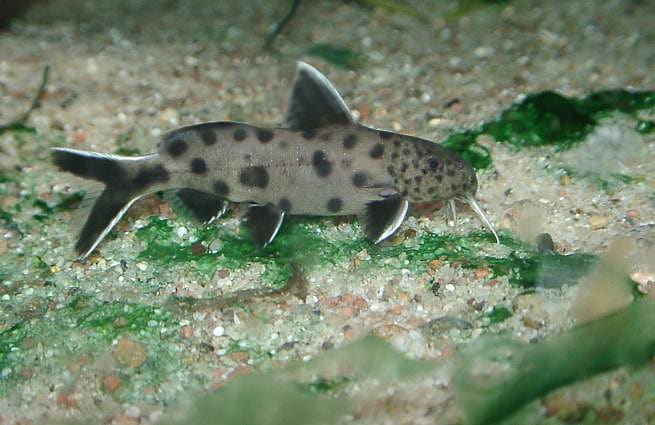
A pocket-sized Lake Tanganyika squeaker described scientifically only in 2006, this is the smallest of the lake's spotted Synodontis and the fish that actually reaches shops under the trade name dwarf petricola. It is copper-brown with irregular black blotches, snow-white barbels and a bright white leading ray in the dorsal and pectoral fins, and it stops at roughly 8 cm standard length (about 10 cm counting the tail), while true Synodontis petricola keeps going to 11-12 cm. The fastest way to tell the two apart is the pale window at the base of each dark triangle on the rayed fins, clearest on the anal and pelvic fins, which gave lucipinnis its name and which petricola lacks; petricola also carries an axillary pore behind the gill and wears finer spots on the head than on the body. Worth knowing when you compare the two profiles: a 2024 revision of Tanganyikan Synodontis proposes treating lucipinnis as a junior synonym of petricola, so the names may yet merge again.
Care
Keep five or six together in hard, alkaline water over soft sand with rock piles and caves, in 100 litres or more with a lid and moderate flow. Peaceful towards anything it cannot swallow, so it fits both Tanganyikan cichlid tanks and ordinary hard-water communities; a lone specimen turns pushy, a group stays out in the open and squeaks contentedly.
Diet
An omnivorous bottom forager that accepts everything from sinking wafers to frozen invertebrates and needs a little vegetable matter each week.
Tankmate compatibility
Gets along with (20)
Possible with care (121)
Avoid (130)
Computed by the AquaSage engine for a spacious reference tank — always check the full verdict for your exact setup in the calculator.
Telling males from females
What works for this species, most reliable first.
- Adult sizeA hint only · only across animals of the same age
In many cichlids, catfish and loaches one sex simply grows larger — usually the male, though there are well-known reversals.
Also in these lists
Frequently asked questions
- What tank size does a Dwarf Petricola Catfish need?
- A Dwarf Petricola Catfish needs an aquarium of at least 100 litres (26.4 US gallons) with a footprint at least 80 cm (31.5 in) long — for this species, swimming length matters as much as raw volume.
- What water parameters does a Dwarf Petricola Catfish need?
- Dwarf Petricola Catfish does best at 22–27 °C (71.6–80.6 °F), pH 7.5–9 and a general hardness of 8–25 °dGH.
- What group size does a Dwarf Petricola Catfish need?
- Dwarf Petricola Catfish is a social species — keep a group of at least 5 so natural behaviour emerges and stress stays low.
- Is the Dwarf Petricola Catfish suitable for beginners?
- Yes — Dwarf Petricola Catfish is one of the easier species to keep and forgives typical first-tank mistakes, as long as the aquarium is cycled and maintained.
Sources
- PlanetCatfish.com – Synodontis lucipinnis (Mochokidae) Cat-eLog
- ScotCat Factsheet no. 205 – Synodontis lucipinnis Wright & Page, 2006
- Synodontis lucipinnis – Wikipedia (after Wright & Page 2006)
- Dwarf Petricola Catfish – Synodontis lucipinnis, Maidenhead Aquatics
- Synodontis lucipinna (= dwarf petricola) – Aquarium Glaser GmbH
- Synodontis lucipinnis – Tanganyika.nl