Cuckoo Catfish
Synodontis multipunctatus
Mochokidae
About
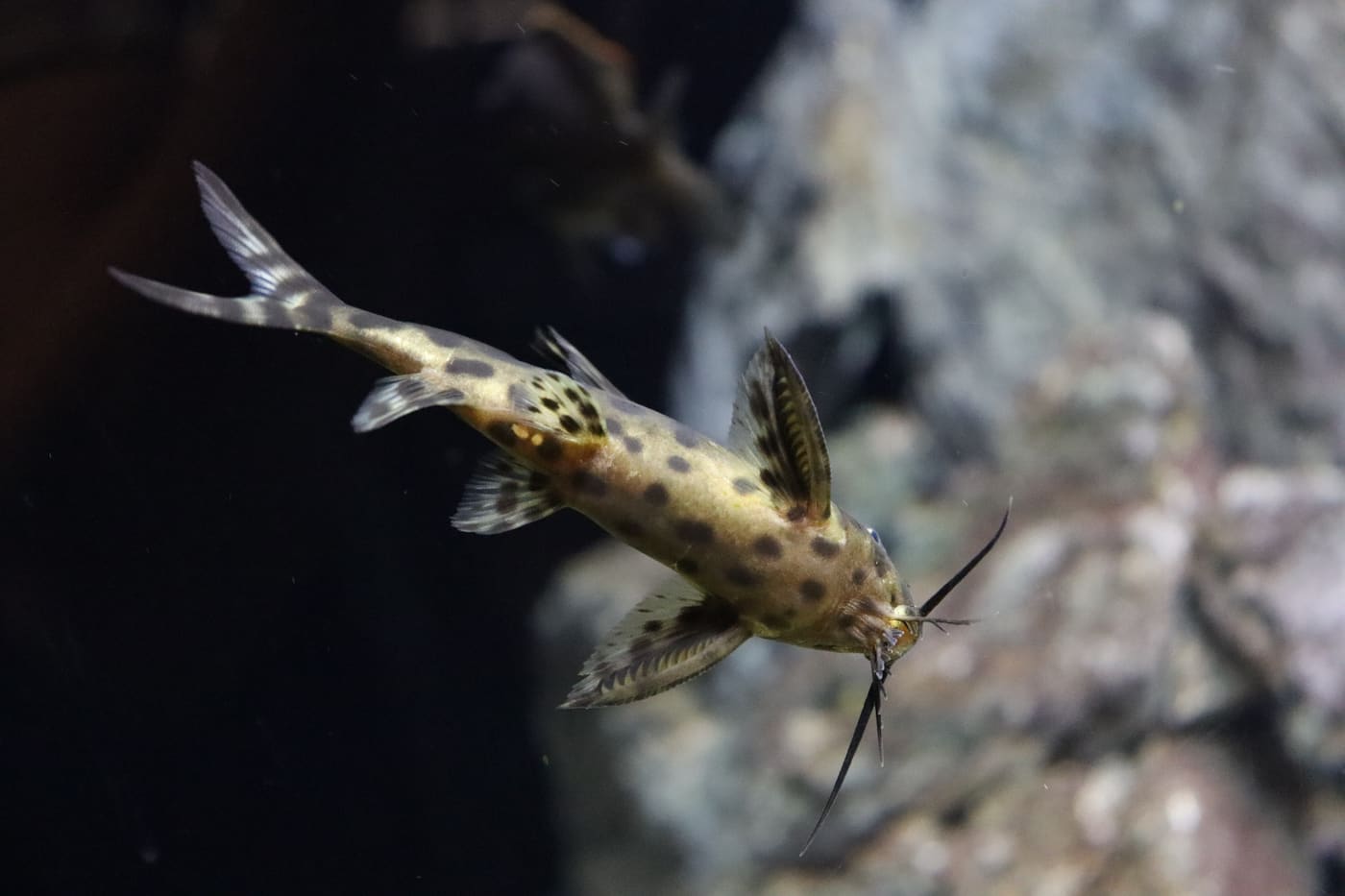
A Lake Tanganyika squeaker that settles at roughly 12-15 cm in the aquarium, although wild specimens have been measured to 27.5 cm. It is a Rift Lake fish, not an Amazonian one, and that is the detail shops most often get wrong: it wants hard, alkaline, strongly buffered water at pH 7.5-9.0 rather than the soft acid conditions its catfish shelf-mates prefer. The species is famous as a brood parasite, the only fish known to pull the trick. A pair spawns in the middle of a mouthbrooding cichlid's spawning run, slips its own eggs into the clutch, and the host picks them up with her own; the catfish fry hatch first and eat her young from inside her mouth. Keep four or more together over sand, with piled rock for cover and subdued lighting, and expect most activity around dusk. Do not confuse it with the smaller Synodontis petricola (about 11.5 cm) or Synodontis lucipinnis (about 8 cm), both of which carry a solid white leading ray in the dorsal and pectoral fins.
Care
Give it hard alkaline water (pH 7.8-8.5, GH 10-25, KH 10-20), a sand bed that spares the barbels, caves built from calcareous rock, and at least 200 L with a 120 cm footprint for a group of four or more. Keep nitrate low, lighting dim, and choose Rift Lake cichlids rather than soft-water community fish as tankmates.
Diet
Meaty foods first: sinking pellets and catfish wafers, frozen or live bloodworm, brine shrimp, krill and daphnia, with blanched peas or courgette a couple of times a week. Feeding in the evening suits its crepuscular habits. It is an effective snail eater, but fish under about 4-5 cm and any eggs it finds are fair game.
Tankmate compatibility
Gets along with (6)
Possible with care (101)
Avoid (164)
Computed by the AquaSage engine for a spacious reference tank — always check the full verdict for your exact setup in the calculator.
Telling males from females
What works for this species, most reliable first.
- Adult sizeA hint only · only across animals of the same age
In many cichlids, catfish and loaches one sex simply grows larger — usually the male, though there are well-known reversals.
Also in these lists
Frequently asked questions
- What tank size does a Cuckoo Catfish need?
- A Cuckoo Catfish needs an aquarium of at least 200 litres (52.8 US gallons) with a footprint at least 120 cm (47.2 in) long — for this species, swimming length matters as much as raw volume.
- What water parameters does a Cuckoo Catfish need?
- Cuckoo Catfish does best at 22–27 °C (71.6–80.6 °F), pH 7.5–9 and a general hardness of 10–25 °dGH.
- What group size does a Cuckoo Catfish need?
- Cuckoo Catfish is a social species — keep a group of at least 4 so natural behaviour emerges and stress stays low.
- Is the Cuckoo Catfish suitable for beginners?
- Yes — Cuckoo Catfish is one of the easier species to keep and forgives typical first-tank mistakes, as long as the aquarium is cycled and maintained.