Dwarf Rasbora
Boraras maculatus
Danionidae
About
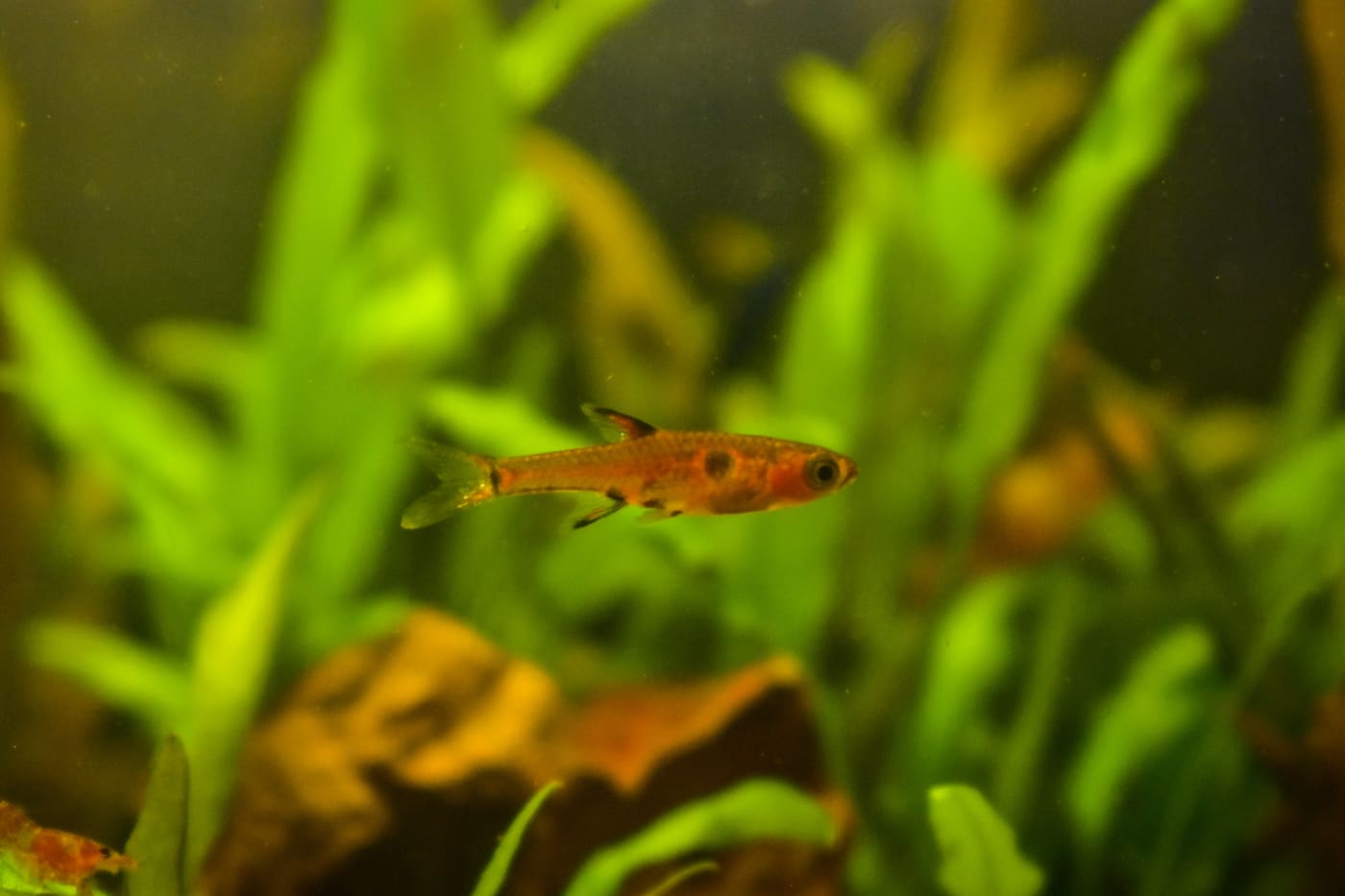
A genuine nano cyprinid from the blackwater peat-swamp streams of Peninsular Malaysia, eastern Sumatra, Singapore and southern Thailand, the dwarf rasbora tops out at roughly 2–2.5 cm. Its warm orange to brick-red body carries one bold dark blotch on the flank plus smaller marks near the anal fin and the tail base, and dominant males colour up far more intensely than the rounder-bellied females. It is naturally shy: on its own or in a token group it hides and stops feeding, while a proper shoal spreads out across mid-water among plants, roots and leaf litter in dim, tannin-stained water.
Care
Keep a shoal of at least 10 (12–20 looks far better) in a mature, densely planted tank of 30 L or more with a 45 cm footprint, soft acidic water, gentle filtration and subdued lighting. Add leaf litter and floating plants for shade, and never mix it with anything fast or large enough to out-compete it at feeding time.
Diet
Micro-predator with a tiny mouth. Offer finely powdered dry food plus daily portions of small live or frozen fare such as cyclops, baby brine shrimp, daphnia and micro worms; dry food alone gives dull colour and poor condition.
Tankmate compatibility
Gets along with (30)
Possible with care (104)
Avoid (137)
Computed by the AquaSage engine for a spacious reference tank — always check the full verdict for your exact setup in the calculator.
Telling males from females
What works for this species, most reliable first.
- Belly depthA hint only · only on well-fed adults, and only as a comparison
For most tetras, barbs and rasboras this is all there is: a conditioned female is deeper through the belly than a male of the same length.
Also in these lists
Frequently asked questions
- What tank size does a Dwarf Rasbora need?
- A Dwarf Rasbora needs an aquarium of at least 30 litres (7.9 US gallons) with a footprint at least 45 cm (17.7 in) long — for this species, swimming length matters as much as raw volume.
- What water parameters does a Dwarf Rasbora need?
- Dwarf Rasbora does best at 22–28 °C (71.6–82.4 °F), pH 4–7 and a general hardness of 1–6 °dGH.
- What group size does a Dwarf Rasbora need?
- Dwarf Rasbora is a social species — keep a group of at least 10 so natural behaviour emerges and stress stays low.
- Is the Dwarf Rasbora suitable for beginners?
- Dwarf Rasbora sits in the middle of the difficulty scale — manageable for a careful beginner who has done the reading, but it has specific needs worth researching first.