Siamese Algae Eater
Crossocheilus oblongus
Cyprinidae
About
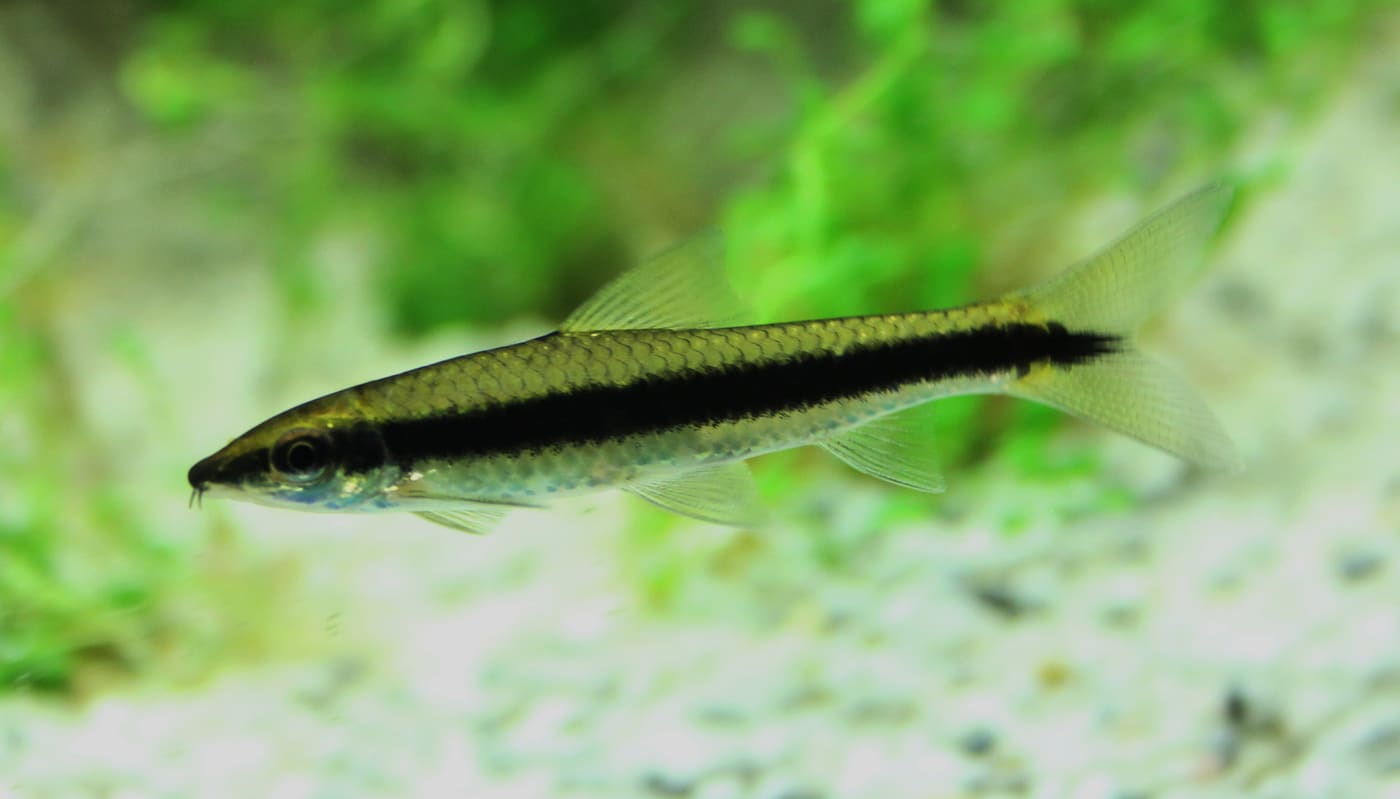
The Siamese Algae Eater is a slender, torpedo-shaped cyprinid from the flowing streams and flooded forests of mainland Southeast Asia, easily told from its many look-alikes by a single bold black stripe running from snout to tail fork over clear, unmarked fins. It is one of the very few aquarium fish that will genuinely eat troublesome hair algae and black beard algae, though its appetite for the job fades as it matures. Peaceful but tireless and reaching around 15 cm, it grows into a boisterous, fast-moving fish that needs a long tank, clean oxygen-rich water and a firm lid.
Care
Give a long, well-oxygenated tank with steady flow, spotless water and a tight lid, as it is a strong jumper. Keep as a single specimen or a group of six or more with space to spread out, alongside similarly robust, fast tankmates.
Diet
Grazes algae and biofilm, including hair and black beard algae when young; supplement with Spirulina foods, algae wafers and blanched vegetables as its algae appetite wanes with age.
Tankmate compatibility
Gets along with (90)
Possible with care (133)
Avoid (48)
Computed by the AquaSage engine for a spacious reference tank — always check the full verdict for your exact setup in the calculator.
Full tank-mates guide with reasons →Telling males from females
What works for this species, most reliable first.
- Colour and patternA hint only · from about 6 months, and only on a settled fish
In rainbowfish, killifish and several barbs the male carries the colour — deeper and more saturated, intensifying further when he displays.
- Extended finsA hint only · from about 8 months, and later in a suppressed male
On many cichlids and killifish the male's dorsal and anal fins draw out into trailing points as he matures, while the female's stay rounded.
- Belly depthA hint only · only on well-fed adults, and only as a comparison
For most tetras, barbs and rasboras this is all there is: a conditioned female is deeper through the belly than a male of the same length.
Also in these lists
Frequently asked questions
- What tank size does a Siamese Algae Eater need?
- A Siamese Algae Eater needs an aquarium of at least 200 litres (52.8 US gallons) with a footprint at least 150 cm (59.1 in) long — for this species, swimming length matters as much as raw volume.
- What water parameters does a Siamese Algae Eater need?
- Siamese Algae Eater does best at 20–26 °C (68–78.8 °F), pH 6–8 and a general hardness of 2–15 °dGH.
- What group size does a Siamese Algae Eater need?
- Siamese Algae Eater is a social species — keep a group of at least 6 so natural behaviour emerges and stress stays low.
- Is the Siamese Algae Eater suitable for beginners?
- Siamese Algae Eater sits in the middle of the difficulty scale — manageable for a careful beginner who has done the reading, but it has specific needs worth researching first.