Bleeding Heart Tetra
Hyphessobrycon erythrostigma
Characidae
About
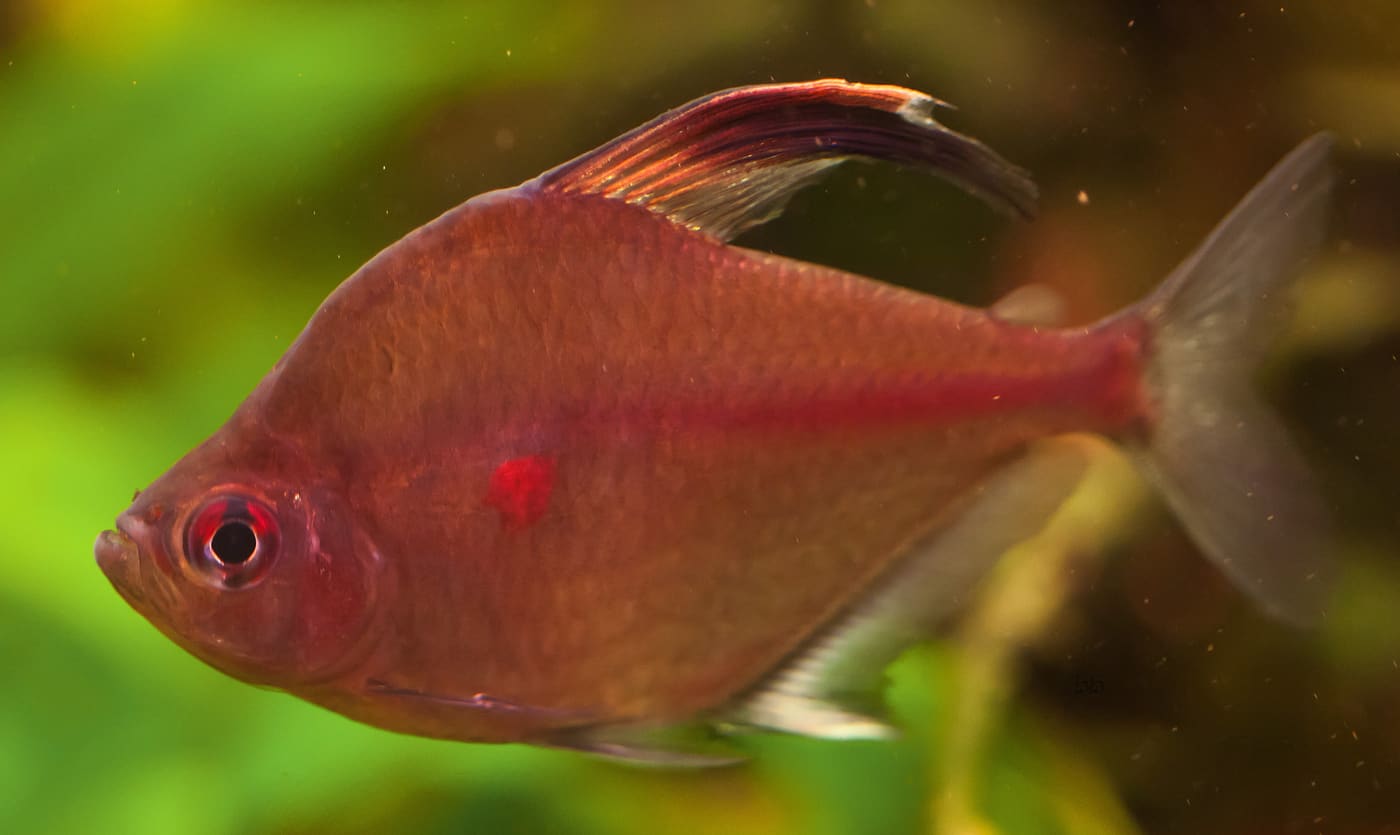
The bleeding heart tetra is a deep, disc-bodied characin from the upper Amazon around the Brazil-Peru-Colombia border, ranging from the rio Purus east to the Nanay near Iquitos. It reaches about 7 cm and is named for the vivid red blotch on the flank just above the pectoral fin, which reads like an open wound. Mature males grow a tall sickle-shaped dorsal and a broad extended anal fin, and spend much of their time sparring and holding space against one another.
Care
Keep a mixed-sex group of at least 8-10 in 110 L or more with a 90 cm base and 40 cm of water depth, in soft acidic water with subdued light and open swimming lanes between the planting. Adult males compete with each other and will worry long-finned tankmates, so bettas and fancy guppies are a poor match.
Diet
Fruit and insects in the wild; in the tank a plant-bearing dry staple plus frozen bloodworm, Daphnia and Artemia.
Tankmate compatibility
Gets along with (77)
Possible with care (103)
Avoid (91)
Computed by the AquaSage engine for a spacious reference tank — always check the full verdict for your exact setup in the calculator.
Telling males from females
What works for this species, most reliable first.
- Belly depthA hint only · only on well-fed adults, and only as a comparison
For most tetras, barbs and rasboras this is all there is: a conditioned female is deeper through the belly than a male of the same length.
Also in these lists
Frequently asked questions
- What tank size does a Bleeding Heart Tetra need?
- A Bleeding Heart Tetra needs an aquarium of at least 110 litres (29.1 US gallons) with a footprint at least 90 cm (35.4 in) long — for this species, swimming length matters as much as raw volume.
- What water parameters does a Bleeding Heart Tetra need?
- Bleeding Heart Tetra does best at 21–28 °C (69.8–82.4 °F), pH 4–7.5 and a general hardness of 1–12 °dGH.
- What group size does a Bleeding Heart Tetra need?
- Bleeding Heart Tetra is a social species — keep a group of at least 8 so natural behaviour emerges and stress stays low.
- Is the Bleeding Heart Tetra suitable for beginners?
- Bleeding Heart Tetra sits in the middle of the difficulty scale — manageable for a careful beginner who has done the reading, but it has specific needs worth researching first.