Rosy Tetra
Hyphessobrycon rosaceus
Characidae
About
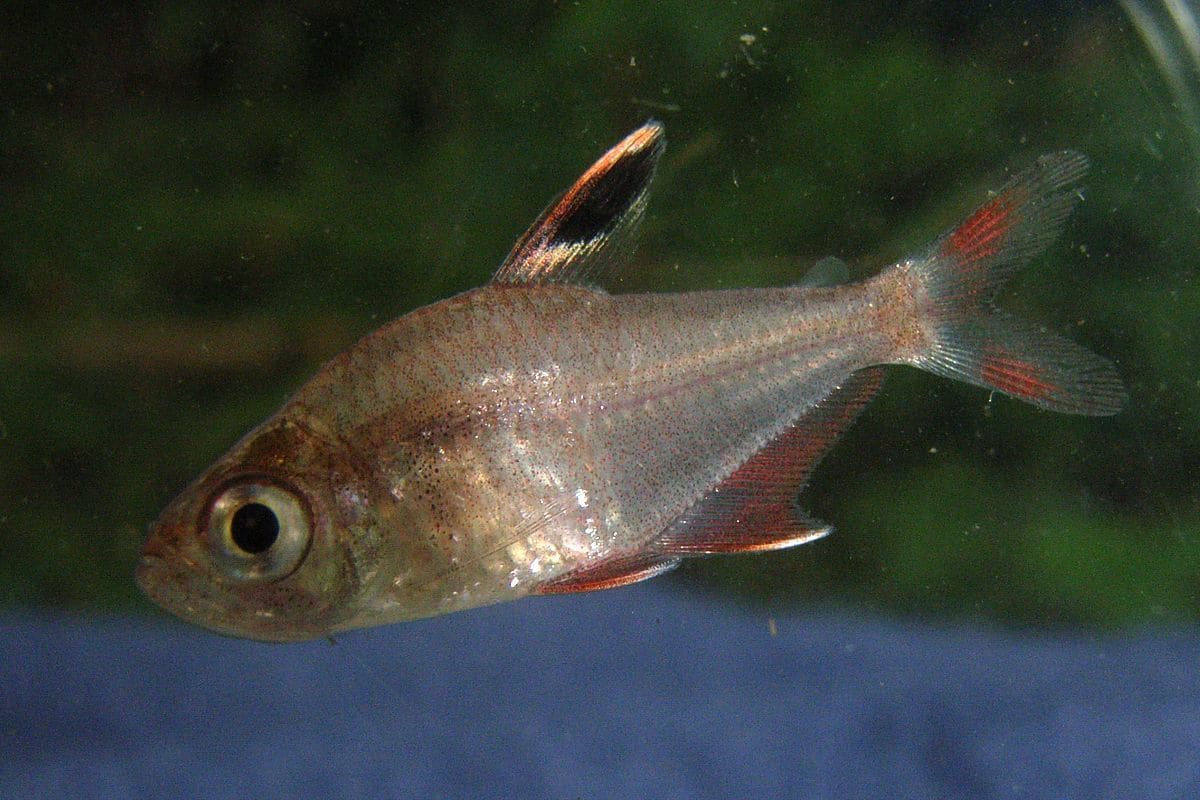
The rosy tetra is a deep-bodied, laterally compressed characin from the Essequibo, Corantijn and Suriname river basins of Guyana, Suriname and Brazil. Its translucent pink body is topped by an extended dorsal fin that mature males flag at one another in constant sparring displays, harmless as long as the group is large enough to spread them around. It is frequently sold under the name of the very similar Hyphessobrycon bentosi, which carries a dark shoulder marking that true H. rosaceus lacks.
Care
Keep 8-10 together in soft, slightly acidic water at 25-27 °C with gentle flow, dark substrate and floating cover. Leave open water for the male displays and skip boisterous tankmates.
Diet
Small-invertebrate feeder; quality flake or micro-granules plus frozen or live daphnia, cyclops and brine shrimp several times a week.
Tankmate compatibility
Gets along with (60)
Possible with care (108)
Avoid (103)
Computed by the AquaSage engine for a spacious reference tank — always check the full verdict for your exact setup in the calculator.
Telling males from females
What works for this species, most reliable first.
- Belly depthA hint only · only on well-fed adults, and only as a comparison
For most tetras, barbs and rasboras this is all there is: a conditioned female is deeper through the belly than a male of the same length.
Also in these lists
Frequently asked questions
- What tank size does a Rosy Tetra need?
- A Rosy Tetra needs an aquarium of at least 70 litres (18.5 US gallons) with a footprint at least 60 cm (23.6 in) long — for this species, swimming length matters as much as raw volume.
- What water parameters does a Rosy Tetra need?
- Rosy Tetra does best at 24–28 °C (75.2–82.4 °F), pH 5.5–7.5 and a general hardness of 1–12 °dGH.
- What group size does a Rosy Tetra need?
- Rosy Tetra is a social species — keep a group of at least 8 so natural behaviour emerges and stress stays low.
- Is the Rosy Tetra suitable for beginners?
- Yes — Rosy Tetra is one of the easier species to keep and forgives typical first-tank mistakes, as long as the aquarium is cycled and maintained.