Checkered Barb
Oliotius oligolepis
Cyprinidae
About
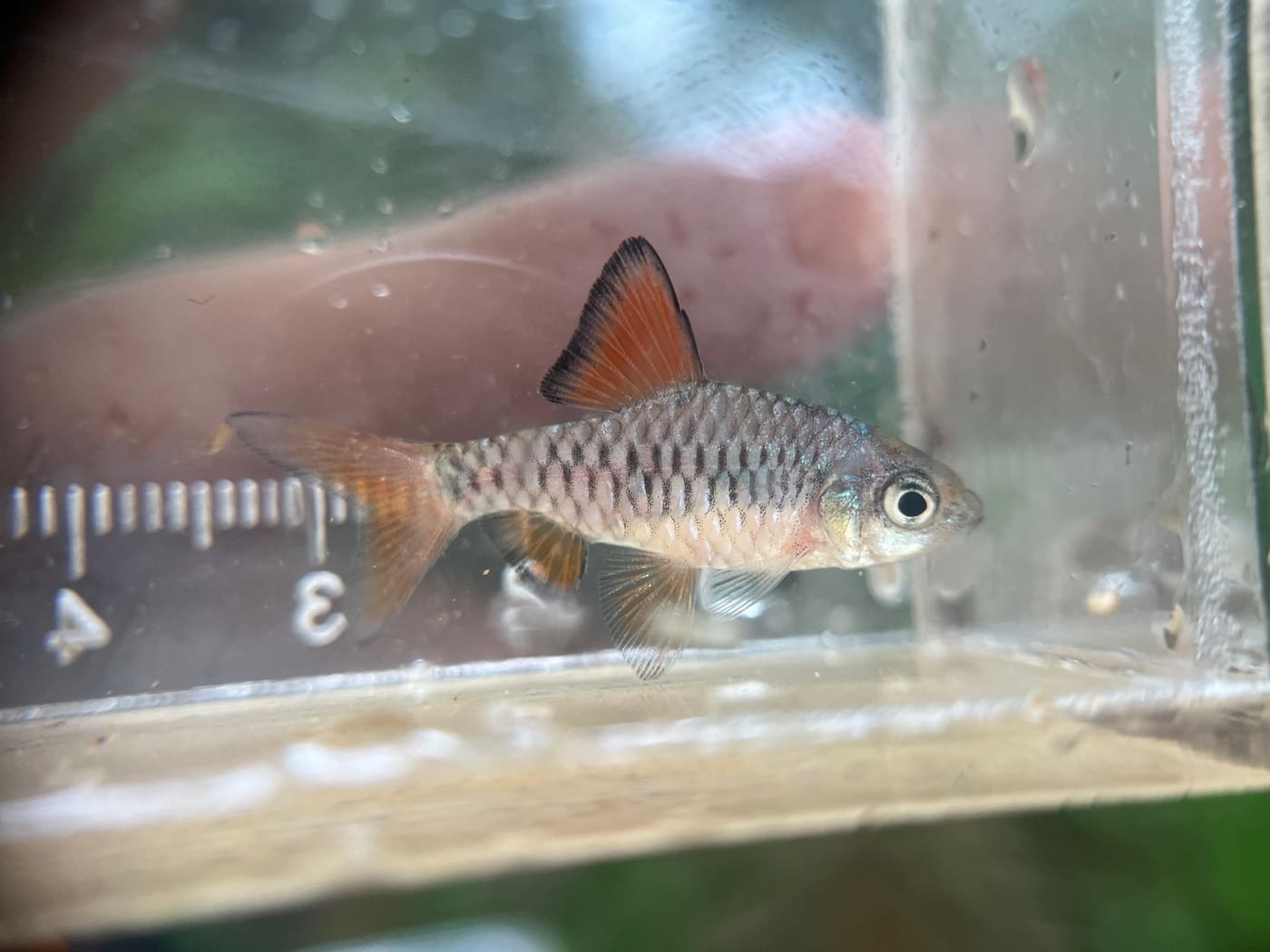
A 5 cm cyprinid endemic to western central Sumatra, with the crater lake Danau Maninjau as its type locality. Its name comes from the pattern: every one of its unusually large scales is outlined by a dark crescent, so the flank reads as a checkerboard grid rather than the bars or stripes worn by most barbs. Males stay smaller and slimmer than females and flush reddish-brown in the dorsal, pelvic and anal fins, each crisply edged in black, while females are plumper and paler with plain yellowish fins. Temperamentally it is nothing like the tiger barb: an active but faintly shy shoaler that spars harmlessly within its own group. It also runs cooler than most tropical community fish, and is happy down to 18 C.
Care
Keep at least 8 in a well-planted tank of 70 litres or more with 75 cm of swimming length, soft slightly acidic water and a cool 20-24 C — a warm room often needs little or no heating. A full-sized shoal keeps the sparring inside the group; in threes and fours they turn on slow, long-finned tankmates and nip.
Diet
Small-gaped omnivore: flake and micro-pellet as the staple, frozen or live daphnia, brine shrimp and bloodworm for colour, plus occasional vegetable matter.
Tankmate compatibility
Gets along with (12)
Possible with care (166)
Avoid (93)
Computed by the AquaSage engine for a spacious reference tank — always check the full verdict for your exact setup in the calculator.
Telling males from females
What works for this species, most reliable first.
- Colour and patternA hint only · from about 6 months, and only on a settled fish
In rainbowfish, killifish and several barbs the male carries the colour — deeper and more saturated, intensifying further when he displays.
- Extended finsA hint only · from about 8 months, and later in a suppressed male
On many cichlids and killifish the male's dorsal and anal fins draw out into trailing points as he matures, while the female's stay rounded.
- Belly depthA hint only · only on well-fed adults, and only as a comparison
For most tetras, barbs and rasboras this is all there is: a conditioned female is deeper through the belly than a male of the same length.
Also in these lists
Frequently asked questions
- What tank size does a Checkered Barb need?
- A Checkered Barb needs an aquarium of at least 70 litres (18.5 US gallons) with a footprint at least 75 cm (29.5 in) long — for this species, swimming length matters as much as raw volume.
- What water parameters does a Checkered Barb need?
- Checkered Barb does best at 18–25 °C (64.4–77 °F), pH 5.5–7.5 and a general hardness of 2–12 °dGH.
- What group size does a Checkered Barb need?
- Checkered Barb is a social species — keep a group of at least 8 so natural behaviour emerges and stress stays low.
- Is the Checkered Barb suitable for beginners?
- Yes — Checkered Barb is one of the easier species to keep and forgives typical first-tank mistakes, as long as the aquarium is cycled and maintained.