Congo Dwarf Cichlid
Nanochromis parilus
Cichlidae
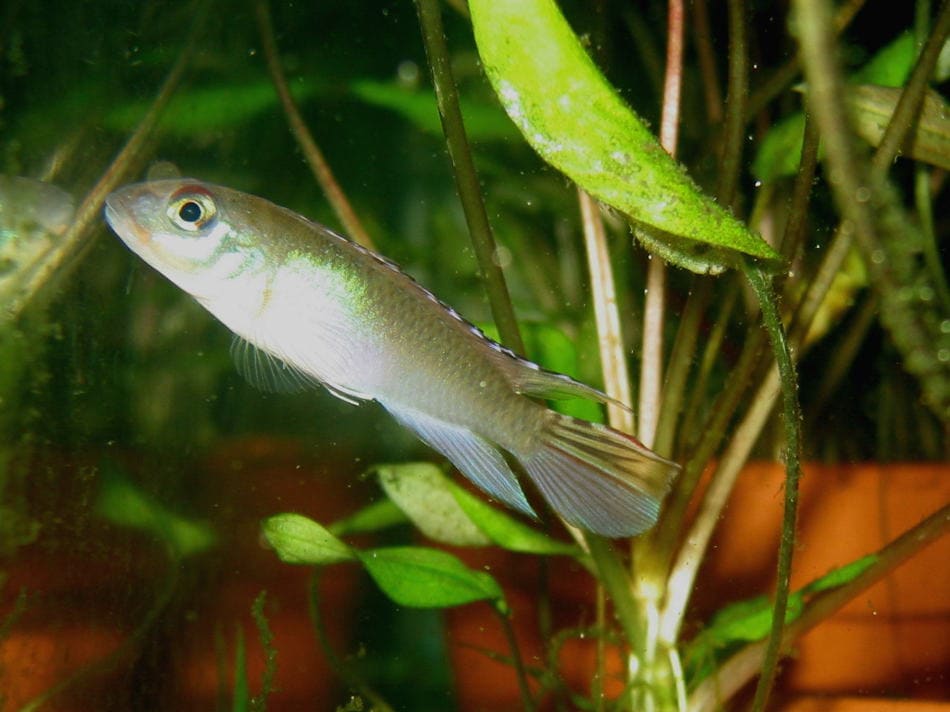
About
The Congo dwarf cichlid is a slender, colourful West African cichlid from the lower Congo River, where males reach about 8 cm and females a little less. A close relative of the kribensis, it forms monogamous pairs and spawns inside caves with shared parental care. It is relatively peaceful toward unrelated tankmates but becomes markedly territorial and pugnacious once a pair claims a breeding cave, and it likes to sift and dig fine sand.
Care
Best kept as a single pair in a 90 L or larger tank over soft sand with caves, driftwood and roots. Provide soft, slightly acidic, high-quality water and expect territorial digging and aggression around a spawning cave.
Diet
Omnivore with a small mouth; feed small sinking pellets and flake supplemented heavily with frozen or live bloodworm, daphnia and brine shrimp. Keep all foods small.
Tankmate compatibility
Gets along with (43)
Possible with care (128)
Avoid (100)
Computed by the AquaSage engine for a spacious reference tank — always check the full verdict for your exact setup in the calculator.
Telling males from females
What works for this species, most reliable first.
- Extended finsStrong · from about 8 months, and later in a suppressed male
On many cichlids and killifish the male's dorsal and anal fins draw out into trailing points as he matures, while the female's stay rounded.
- VentingA hint only · only on a mature fish, easiest when she is in breeding condition
The method breeders use when the answer has to be right. Hold the fish upside down in a wet hand or soft net and look at the two openings ahead of the anal fin. The forward one is the anus; the one behind it is what you are reading.
- Adult sizeA hint only · only across animals of the same age
In many cichlids, catfish and loaches one sex simply grows larger — usually the male, though there are well-known reversals.
Also in these lists
Frequently asked questions
- What tank size does a Congo Dwarf Cichlid need?
- A Congo Dwarf Cichlid needs an aquarium of at least 90 litres (23.8 US gallons) with a footprint at least 60 cm (23.6 in) long — for this species, swimming length matters as much as raw volume.
- What water parameters does a Congo Dwarf Cichlid need?
- Congo Dwarf Cichlid does best at 22–26 °C (71.6–78.8 °F), pH 6–7.5 and a general hardness of 1–10 °dGH.
- Is the Congo Dwarf Cichlid suitable for beginners?
- Congo Dwarf Cichlid sits in the middle of the difficulty scale — manageable for a careful beginner who has done the reading, but it has specific needs worth researching first.