Green Discus
Symphysodon tarzoo
Cichlidae
About
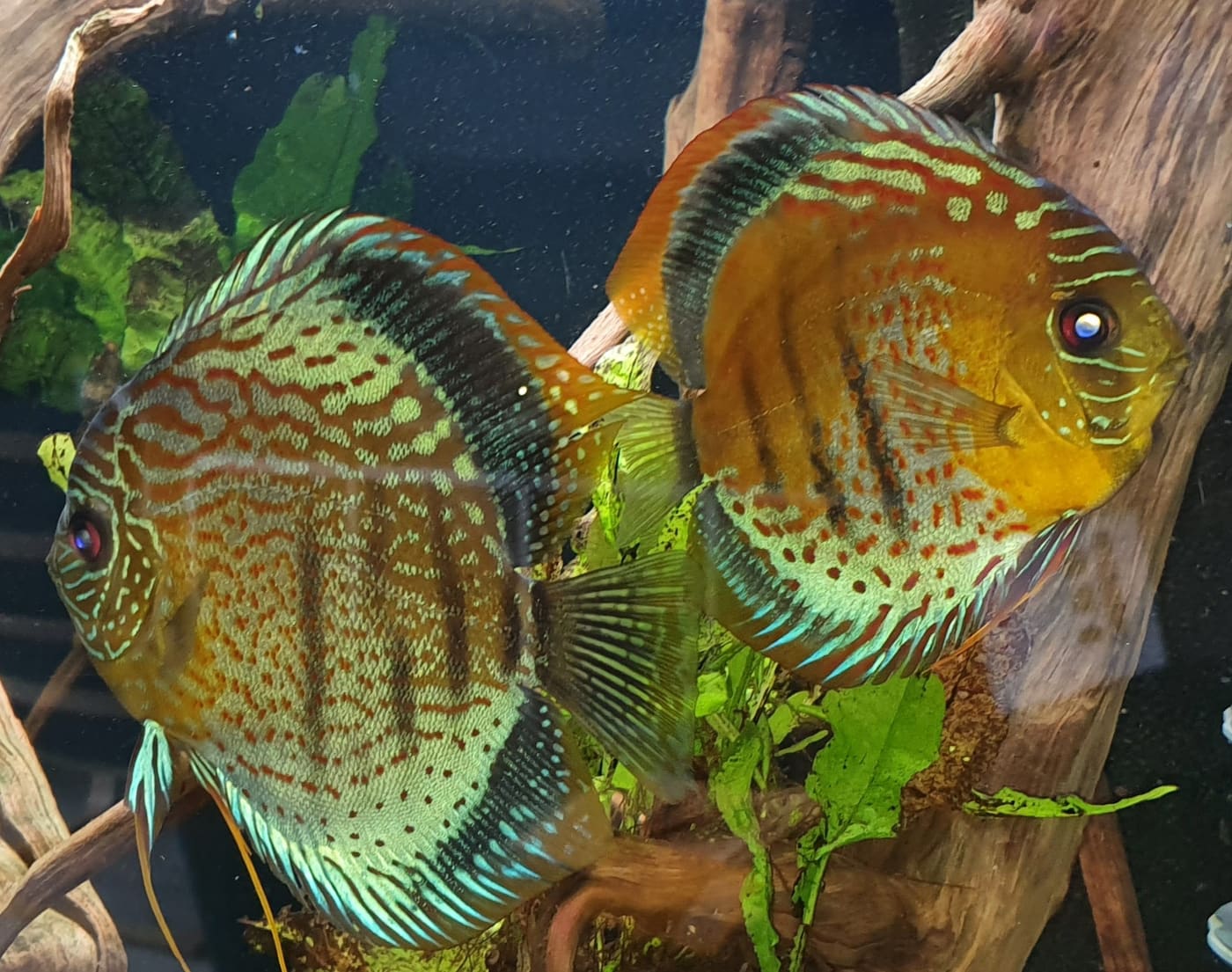
The green discus is the western Amazon member of the discus group, separated from Symphysodon aequifasciatus by the Purus arch — a geological divide between Manaus and the Rio Bauana — and told apart by the red spotting scattered over its body and anal fin. Its taxonomy is genuinely unsettled and we would rather say so than pick a winner: FishBase and the GBIF backbone treat S. tarzoo as a valid species, the Catalog of Fishes goes further and recognises four, Bleher's 2007 revision applies the same two names the other way round, and some authors argue Lyons' 1959 name was never validly published and should give way to S. haraldi. We follow the FishBase and GBIF usage here. In the water none of that matters: this is a discus like any other, a tall, disc-shaped, shy blackwater cichlid from flooded forest and floodplain lagoons that wants very warm, very soft, acidic water, a group of six or more, and spotless maintenance.
Care
Keep it exactly as you would any other discus: a tall tank of 250 L or more and around 50 cm deep, 28-30 C, soft acidic water and frequent large water changes. Wild-caught greens come from pH 4.8-5.9 blackwater and want the soft, acidic end of that range, while tank-bred stock is comfortable at 6-7. Keep six or more and choose only calm, slow-feeding tankmates.
Diet
Omnivore leaning carnivorous and a slow, deliberate feeder that is easily out-competed. Feed frozen bloodworms, brine shrimp and blackworms plus quality granules in small, frequent meals. Expect wild-caught fish to refuse dry food at first.
Tankmate compatibility
Gets along with (3)
Possible with care (126)
Avoid (142)
Computed by the AquaSage engine for a spacious reference tank — always check the full verdict for your exact setup in the calculator.
Telling males from females
What works for this species, most reliable first.
- Extended finsStrong · from about 8 months, and later in a suppressed male
On many cichlids and killifish the male's dorsal and anal fins draw out into trailing points as he matures, while the female's stay rounded.
- VentingA hint only · only on a mature fish, easiest when she is in breeding condition
The method breeders use when the answer has to be right. Hold the fish upside down in a wet hand or soft net and look at the two openings ahead of the anal fin. The forward one is the anus; the one behind it is what you are reading.
- Adult sizeA hint only · only across animals of the same age
In many cichlids, catfish and loaches one sex simply grows larger — usually the male, though there are well-known reversals.
Also in these lists
Frequently asked questions
- What tank size does a Green Discus need?
- A Green Discus needs an aquarium of at least 250 litres (66 US gallons) with a footprint at least 120 cm (47.2 in) long — for this species, swimming length matters as much as raw volume.
- What water parameters does a Green Discus need?
- Green Discus does best at 27–31 °C (80.6–87.8 °F), pH 5–7.5 and a general hardness of 1–12 °dGH.
- What group size does a Green Discus need?
- Green Discus is a social species — keep a group of at least 6 so natural behaviour emerges and stress stays low.
- Is the Green Discus suitable for beginners?
- Green Discus is a demanding species best attempted with some experience — it needs stable, closely watched conditions to thrive.