Elephantnose Fish
Gnathonemus petersii
Mormyridae
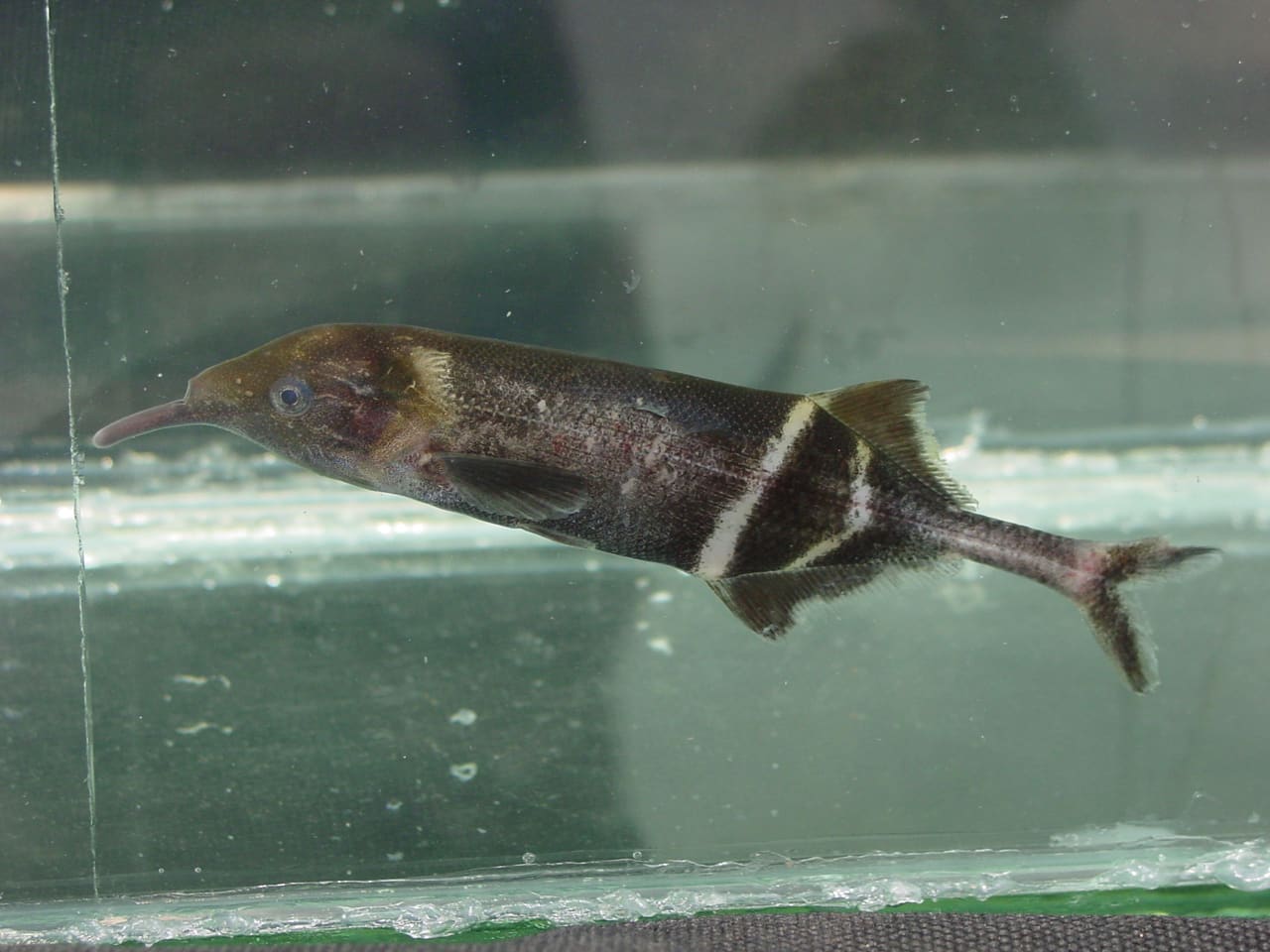
About
A weakly electric oddball from the Niger and Congo river basins of Africa. The velvety dark-brown body carries two pale bands near the forked tail, and the famous 'trunk' is really a flexible, touch-sensitive chin appendage used to probe soft sand for worms after dark. Nocturnal and shy, it navigates, hunts and even communicates through weak electric pulses, and its brain-to-body ratio is among the largest of any fish.
Care
Needs a 250 L, 120 cm-long tank with soft sand, dim light and plenty of caves and driftwood. Extremely sensitive to copper, medications, salt and rising nitrate — only mature, pristine water. Keep one per tank and pair it with calm, non-boisterous tankmates.
Diet
Feed live or frozen bloodworm, blackworm, daphnia and mosquito larvae after lights-out; it is a slow, specialist feeder that is easily outcompeted and often ignores dry food.
Tankmate compatibility
Gets along with (41)
Possible with care (144)
Avoid (86)
Computed by the AquaSage engine for a spacious reference tank — always check the full verdict for your exact setup in the calculator.
Telling males from females
There is no reliable way to sex this species by eye. That is the honest answer, not a gap in our data.
All the methods, with diagramsAlso in these lists
Frequently asked questions
- What tank size does a Elephantnose Fish need?
- A Elephantnose Fish needs an aquarium of at least 250 litres (66 US gallons) with a footprint at least 120 cm (47.2 in) long — for this species, swimming length matters as much as raw volume.
- What water parameters does a Elephantnose Fish need?
- Elephantnose Fish does best at 22–28 °C (71.6–82.4 °F), pH 6–7.5 and a general hardness of 5–15 °dGH.
- Is the Elephantnose Fish suitable for beginners?
- Elephantnose Fish is a demanding species best attempted with some experience — it needs stable, closely watched conditions to thrive.