Lambchop Rasbora
Trigonostigma espei
Cyprinidae
About
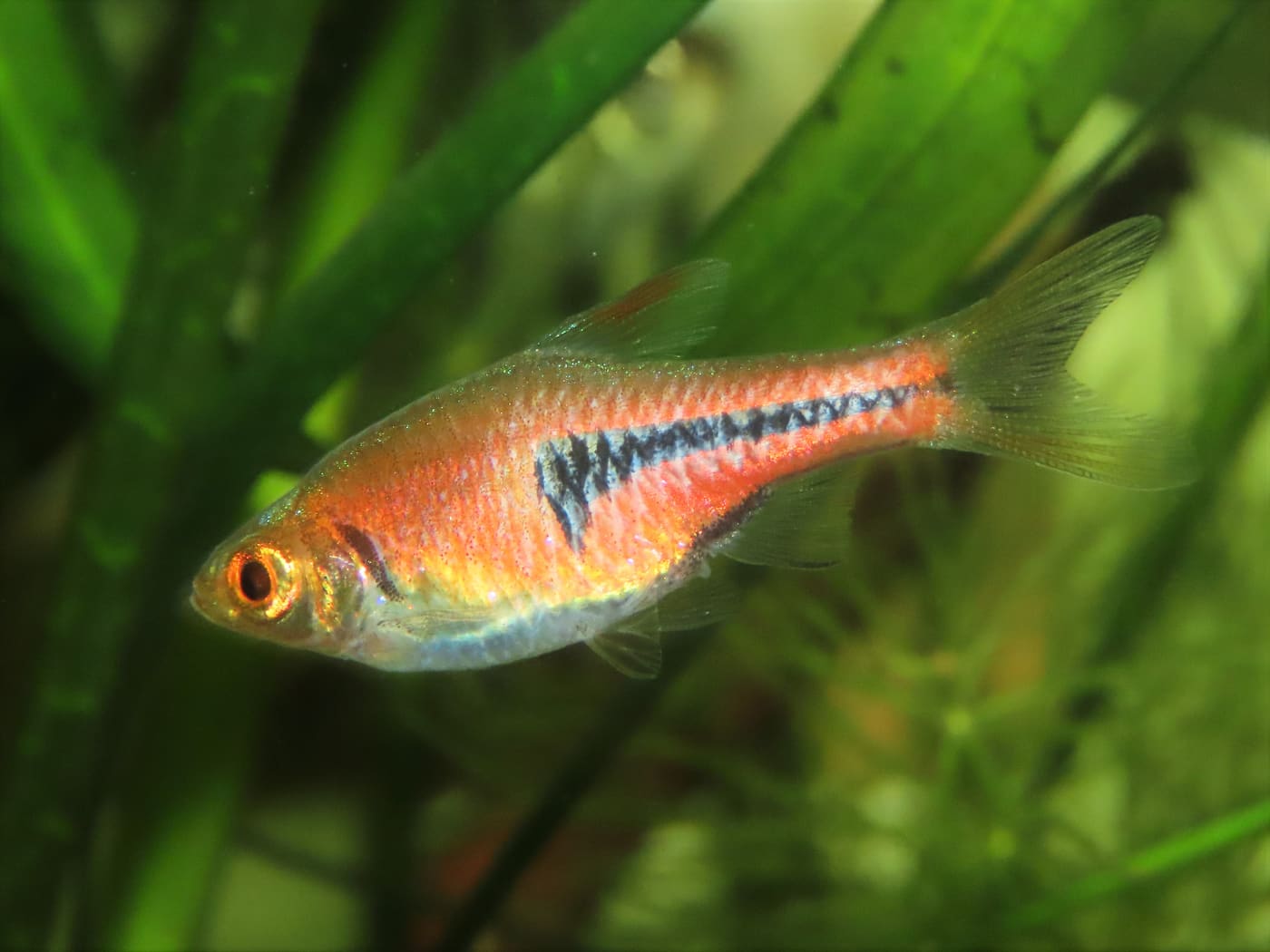
The lambchop rasbora is a small, coppery-orange shoaling cyprinid from the slow blackwater streams, ponds and swamps of Thailand and Cambodia, named for the tapering black lambchop-shaped mark along its rear flank. A slimmer, more subtly coloured cousin of the harlequin, it is peaceful and undemanding, and looks its best in a densely planted, dimly lit tank kept in a tight group.
Care
Keep in a shoal of 8 or more in soft, slightly acidic, well-planted water with gentle flow and dim lighting. A peaceful nano community fish best paired with similarly small, calm tankmates.
Diet
Micro-omnivore that hunts tiny invertebrates in midwater; feed small dry foods plus frequent frozen or live micro-foods to bring out its colour.
Tankmate compatibility
Gets along with (48)
Possible with care (123)
Avoid (100)
Computed by the AquaSage engine for a spacious reference tank — always check the full verdict for your exact setup in the calculator.
Telling males from females
What works for this species, most reliable first.
- Belly depthA hint only · only on well-fed adults, and only as a comparison
For most tetras, barbs and rasboras this is all there is: a conditioned female is deeper through the belly than a male of the same length.
Also in these lists
Frequently asked questions
- What tank size does a Lambchop Rasbora need?
- A Lambchop Rasbora needs an aquarium of at least 45 litres (11.9 US gallons) with a footprint at least 60 cm (23.6 in) long — for this species, swimming length matters as much as raw volume.
- What water parameters does a Lambchop Rasbora need?
- Lambchop Rasbora does best at 23–28 °C (73.4–82.4 °F), pH 5.5–7.5 and a general hardness of 1–12 °dGH.
- What group size does a Lambchop Rasbora need?
- Lambchop Rasbora is a social species — keep a group of at least 8 so natural behaviour emerges and stress stays low.
- Is the Lambchop Rasbora suitable for beginners?
- Yes — Lambchop Rasbora is one of the easier species to keep and forgives typical first-tank mistakes, as long as the aquarium is cycled and maintained.