White spot (ich)
Treat nowParasiteIchthyophthirius multifiliis
Also called: Ich, Ichthyophthiriasis
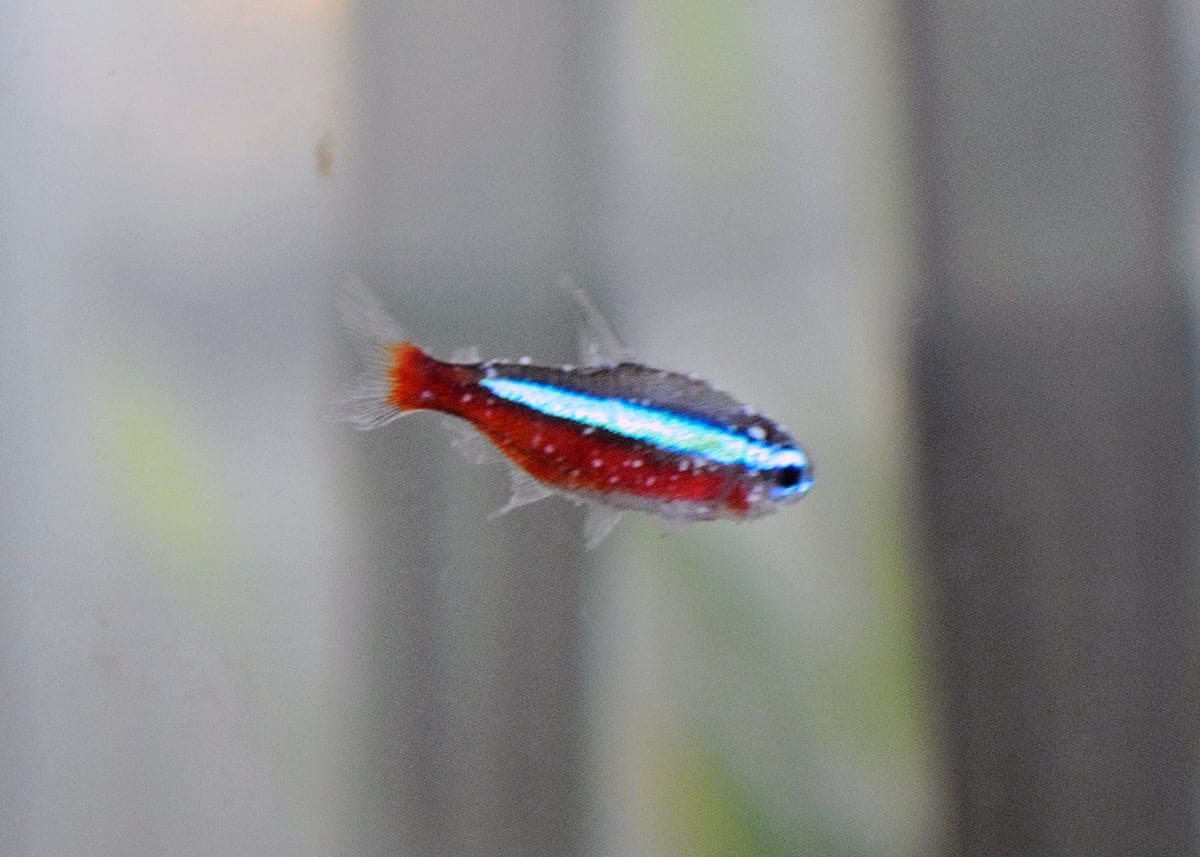
What you see
Discrete white spots of about 1 mm, like grains of salt or semolina, scattered over the body and fins. Fish rub against decor, clamp their fins and later gasp — the parasite hits the gills hardest, so a fish can be suffocating while only a few spots show on the skin.
How to tell it from its look-alikes
The separator is the shape of the spot: ich spots are discrete, round and raised, like grains. Velvet is far finer — not spots but a gold-coloured dust. Columnaris lesions are not spots at all but flat, yellowish, spreading patches. Male goldfish in breeding condition grow similar white tubercles on the gill plates — that is a sex trait, not a disease.
The separator from ich is grain size: velvet is dust-fine with a gold or rust tint, while ich forms discrete white grains. Rubbing (flashing) is common to both, so it separates nothing. When unsure, use a flashlight in a dark room — a dust sheen glitters, grains stay as dots.
It differs from ich in shape: not discrete round grains but flat, spreading patches. From true fungus it differs three ways: the columnaris film lies flat rather than tufting upward, is often yellowish rather than grey-white, and spreads faster — visibly within a day or two, where fungus takes several days. Only a microscope separates these two for certain — so when in doubt, act as if it were columnaris, the faster and deadlier of the pair.
The dangerous mistake
Raising the temperature. No veterinary source recommends heating a tank to treat ich — heat only speeds the parasite's multiplication, and if the white marks are actually columnaris, warmer water makes the bacterium deadlier still. Temperature only sets the treatment schedule: above 26 °C, medicate daily.
Water first
In a young tank, most “disease” is not disease — it is ammonia or nitrite poisoning, and no medicine treats that. Before buying anything, test ammonia, nitrite and nitrate. If you keep the cycle log, the answer is already there.
New tank syndromeWhat to do
Treat the whole tank, not one fish — medication only reaches the free-swimming stage, never the one already under the skin, so the full labelled course matters. Products based on malachite green with formaldehyde are sold in Lithuanian shops (e.g. sera Costapur), and preparations of this composition are authorised ornamental-fish medicines in EU member states. Dose precisely: malachite green's therapeutic dose is not far from a harmful one, especially for goldfish — and for scaleless species such as corydoras and loaches the research literature advises against malachite green altogether: with those fish in the tank, choose a product whose label explicitly allows them, or ask a veterinarian.
What to expect
Caught early and treated through a full course, most fish recover. A neglected infection, especially one that has reached the gills, kills — and survivors carry some resistance to reinfection for a while.
This reference helps you recognise and tell conditions apart — it does not make the diagnosis. Only a microscope or a veterinarian confirms one. Use medicines exactly per the label, ideally in a quarantine tank, because several of them kill filter bacteria.
Sources
- https://aquaculture.mgcafe.uky.edu/sites/aquaculture.ca.uky.edu/files/srac_476_ich_white_spot_disease.pdf
- https://ask.ifas.ufl.edu/publication/FA006
- https://www.merckvetmanual.com/exotic-and-laboratory-animals/aquarium-fish/parasitic-diseases-of-fish
- https://medicines.health.europa.eu/veterinary/en/600000097999
- https://strathprints.strath.ac.uk/91716/1/Reviews_in_Aquaculture_-_2024_-_Larcombe_-_Current_disease_treatments_for_the_ornamental_pet_fish_trade_and_their.pdf