Pygmy Chain Sword
Helanthium tenellum
Alismataceae
About
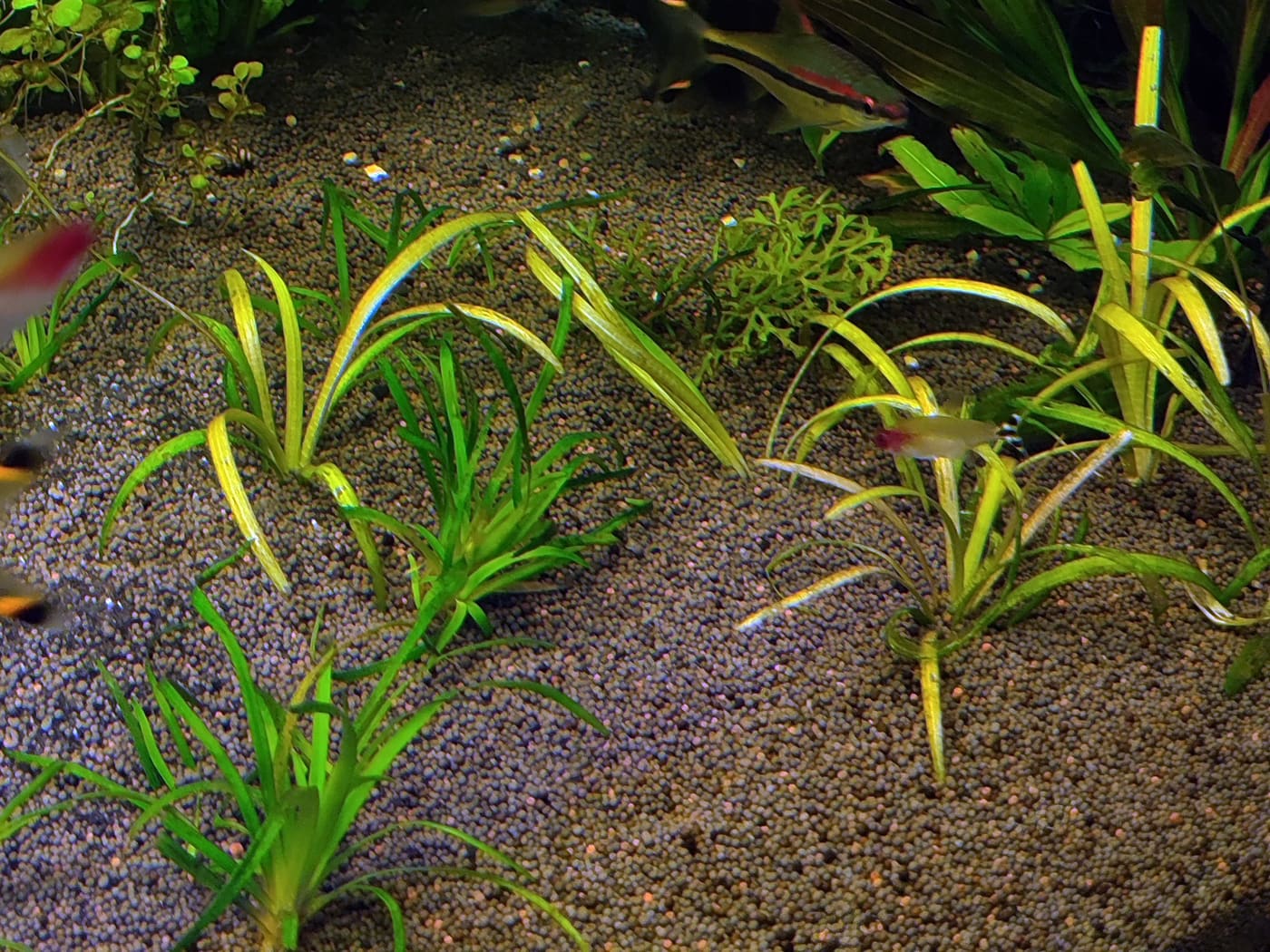
Helanthium tenellum is the grassy dwarf sword that most shops still label Echinodorus tenellus. Grown properly it is a 5-10 cm turf of flat, paper-thin blades barely 1.5-2 mm wide, olive green, spreading by runners that creep across the top of the substrate rather than under it and drop a new plantlet every 2-5 cm along chains up to half a metre long. Unhappy, it does not melt or rot; it stretches. Starved of light, or quietly shaded by the plants that grew up behind it, the leaves reach for the surface and can run to 30-50 cm, turning a foreground carpet into a lank green curtain. At medium light with little CO2 and few nutrients it fails the other way: it stays under 5 cm, spreads slowly and leaves bare substrate showing between the rosettes. Driven hard it also grows taller - strong light plus rich water speeds the runners but lengthens the blades with them, which is why a hard cut-back rather than a gentle trim is what produces a dense grass carpet. Cold stops it: below about 22 C it barely grows, and although it survives down to 16 C it will put out almost no new runners there, so a cool tank stays as bare as the day you planted it. How much light and CO2 it really needs is contested. Tropica rates its 'Green' cultivar low light and low CO2, and AquaInfo says average light with no CO2 and no fertiliser will do; Flowgrow (medium-high light, 20-40 mg/l CO2), Dennerle (high-medium light, 20-30 mg/l) and Aquasabi - which states flatly that a true lawn effect is only obtained at high light and that the plant must not stand in the shade of larger plants - disagree. We follow the demanding side, because the lenient sources describe survival and the demanding ones describe a carpet: in a shaded low-tech tank it lives, but as a sparse or a stretched stand, not a lawn. The red in catalogue photos is conditional twice over, because only the narrow-leaved form colours at all and only under strong light with generous iron and NPK, while the broad-leaved 'Green', 'Broad Leaf' and parvulum forms stay light green under any lamp you hang over them. On the shop bench it is confused with Sagittaria subulata, whose leaves are thick, fleshy and rarely under 5 mm wide and whose runners travel below the substrate, and with its own sibling form: parvulum leaves are broader and widest below the middle, true tenellum leaves are widest above the middle, about 2 cm from the tip. Some broad-leaf stock is sold, wrongly, as Ranalisma rostrata, which is a different plant altogether.
Care
Plant single rosettes a few centimetres apart with tweezers in sand or fine rounded gravel, because the roots are brittle; strip the rock wool off first and set each crown level with the substrate rather than under it, or it rots instead of rooting. Feed from below with root tabs rather than relying on the water column. Potted plants arrive in the emersed land form and shed those leaves; the narrow submerged blades follow in two to three weeks, and in-vitro cups skip that phase entirely. Give it the brightest unshaded spot in the foreground - the moment taller neighbours close over it, it stops carpeting and starts climbing - cut it back hard to force density, and thin the runners before the plantlets overlap and rot the layer underneath.
Diet
Takes most of its nutrients through the roots, so an enriched substrate or root tabs matter more than water-column dosing; iron and a full NPK background are what turn the narrow form red rather than olive, and without them it stays green however bright the lamp.
Also in these lists
Frequently asked questions
- What water parameters does a Pygmy Chain Sword need?
- Pygmy Chain Sword does best at 16–30 °C (60.8–86 °F), pH 5–8 and a general hardness of 0–20 °dGH.
- Where should Pygmy Chain Sword be placed in the aquarium?
- Pygmy Chain Sword works best in the foreground and reaches around 15 cm.
- Is the Pygmy Chain Sword suitable for beginners?
- Pygmy Chain Sword sits in the middle of the difficulty scale — manageable for a careful beginner who has done the reading, but it has specific needs worth researching first.
Sources
- Helanthium tenellum - Grasartige Zwergschwertpflanze - Flowgrow Wasserpflanzen-Datenbank
- Helanthium tenellum "parvulum" - Flowgrow Wasserpflanzen-Datenbank
- Helanthium tenellum 'Green' - Tropica Aquarium Plants
- Helanthium tenellum ("Red") | Aquasabi
- Helanthium tenellum "Green" | Aquasabi
- Helanthium tenellum 'Red' - Dennerle Plants
- Helanthium tenellum - AquaInfo
- Helanthium tenellum Species | Tropical Fish Hobbyist Magazine
- Helanthium tenellum / Species detail / Plant Atlas (USF)
- Helanthium tenellum (Mart. ex Schult.f.) J.G.Sm. | Plants of the World Online, Kew