New Zealand Micro Sword
Lilaeopsis novae-zelandiae
Apiaceae
About
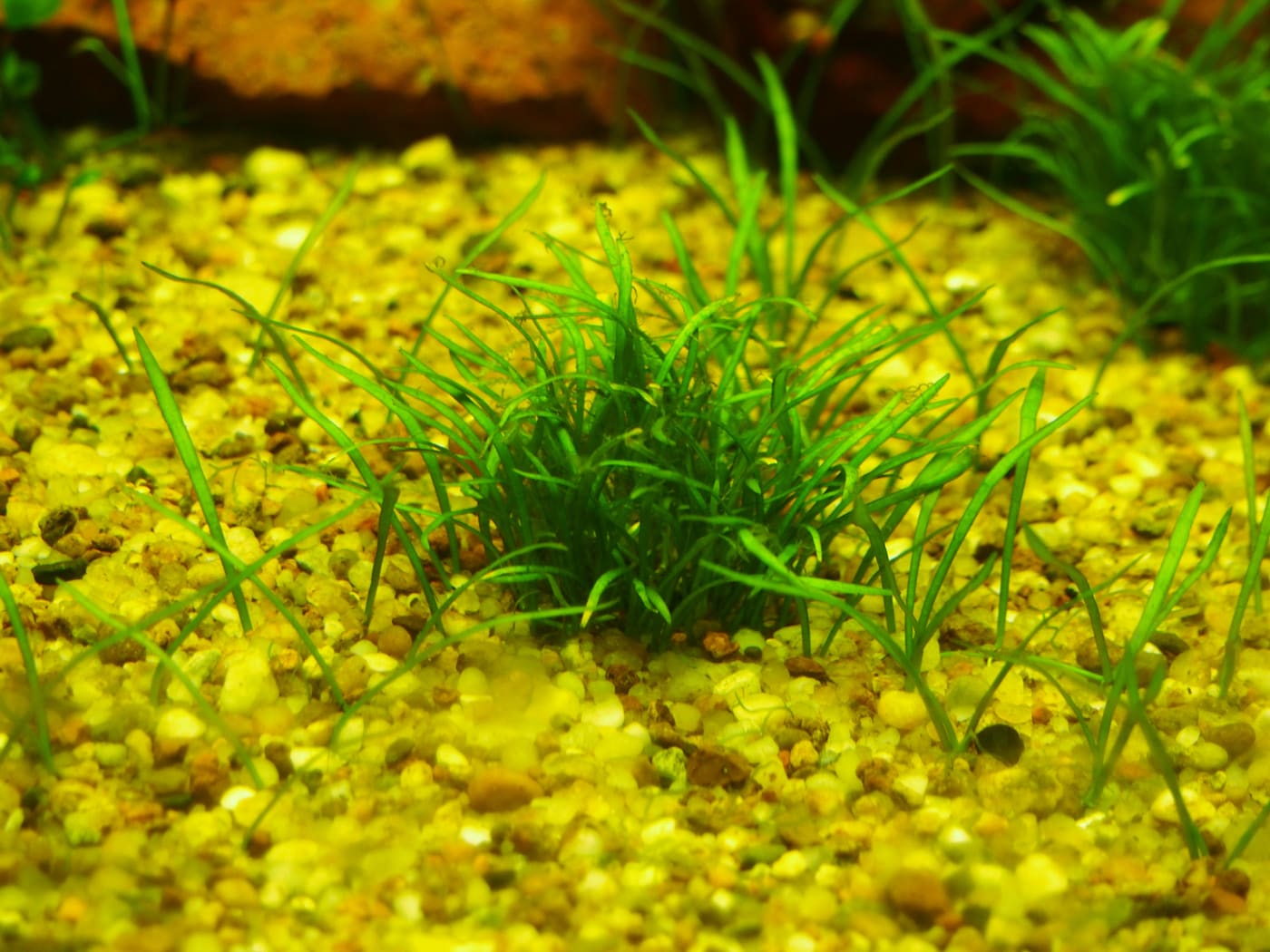
Every shop that sells this plant sells a name botany has walked away from. The true Lilaeopsis novae-zelandiae ((Gand.) A.W.Hill) is a New Zealand wetland plant - the NZ Plant Conservation Network files it as a Not Threatened endemic, while Kew and Wikipedia extend the range to Tasmania - and Flowgrow, the one database that would normally hand us the numbers, publishes not one of them under this name: no temperature, no pH, no hardness, no light rating, no height. Its aquarium-suitability field reads 'unbekannt' and its text says the species is probably not in aquarium culture at all; in the wild it grows on brackish coastal ground. What is in the pot instead is Lilaeopsis brasiliensis, which this catalogue lists separately as Brazilian micro sword, or - where the blades are round in cross-section - most likely Lilaeopsis ruthiana, an inland New Zealand species that holds its own Flowgrow entry and has been cultivated successfully in tanks. We keep this entry because the label is real even where the species is not, and we do not carry L. ruthiana in the synonyms for the same reason the sibling page does not carry L. attenuata: it is a separate accepted species, not another name for this one. Two things follow for the buyer. First, difficulty. Every rating that calls this plant easy is a shop's - Aqua Essentials badges it 'Easy care', Buce Plant 'Easy to Moderate', Aquarium Breeder 'Easy-Medium' - and all three are measuring whether it stays alive. The only complete parameter set ever published under this name is Tropica's own, archived at AC Tropical Fish, and its Demands field reads 'difficult'. We follow the grower, which is why this entry sits a step harder than the Brazilian micro sword beside it even though most pots hold that plant: that entry has four databases behind it, this label has none. Second, height, and whose card says what. The famous promise - a 'lawn effect' of 4-7 cm 'only achieved at high light intensity' - is printed on Tropica's L. brasiliensis card, item 040. Tropica has never catalogued a novae-zelandiae, and there is no item 040A. Under this name the archived Tropica set records 6-12 cm at light 'medium-very high', and that taller figure is our height field: it is what an under-lit tank produces. Grown well, the plant is a lawn of dark green, rush-like blades tapering to a sharp point, tufts of them rising every few centimetres from runners that thread just under the sand, with new tufts breaking surface ahead of the old ones. Grown badly it does not die back - it stalls, and the reviews at the one UK shop still selling under this exact name read like a catalogue of that state: 'neither died nor grown' after a couple of weeks, 'runners very slow growing', 'slow ish grower'. Weeks of standstill are normal, and it is the gaps between tufts that refuse to close. Shade is the commonest cause and the easiest to miss: Tropica's instruction is to place it in an open position without shading from other plants, Aquarium Breeder's is to avoid shaded spots at planting, and a neighbour that grew in later counts the same. CO2 is where we part company with the shops. Buce calls it 'Recommended (Accelerates carpet density)' and says the plant will manage in a low-tech tank; Aqua Essentials says it is 'not always essential'. Both are describing survival. On the carpet itself Aquarium Breeder is blunt - without CO2 'the likely outcome would be a moderately growing, sparse carpet', and 'for a luxuriant carpet, essentially, CO2 is a huge requirement for this plant species' - and Flowgrow prints 10-40 mg/l for the plant that is actually in the pot. We file CO2 as required and say plainly that the field is contested, rather than splitting the difference at 'beneficial'. Algae are the second failure mode, and the sources place them precisely: the grass is susceptible to algal growth 'especially if the light is excessive and nutrients are plentiful', which leaves 'the carpet completely messy'. That is light running ahead of nutrients and CO2, not a stall under a strong lamp; no source we could check names hair algae specifically or claims the blades are too fine to clean, and the published remedy is the ordinary one - prune the fouled and decaying shoots out and keep the mat cut low. Two more failure modes are mechanical. Freshly bought emersed stock melts its foliage on going under, and that one is transitional: the plant recovers once it settles. And until the runners knit, tufts 'might detach from the substrate after planting' and want pushing back in - which is also why the gravel vacuum is the wrong tool here. The published routine is to stir the carpet gently at cleaning so debris, food particles and detached shoots lift into the water, then siphon them off there. Keep crayfish and freshwater crabs out of the tank entirely: they 'will cut, eat, and uproot everything'. The green in our photo is not conditional - no source describes a red or otherwise coloured form of this plant, and light here buys compactness and density, never pigment. In the shop the one test that works is tactile. Roll a blade between finger and thumb: a flat ribbon is brasiliensis, a round needle is the form Flowgrow attributes to L. ruthiana, and it is that round-leaved plant this label was coined for. Dwarf hairgrass (Eleocharis parvula) is round-leaved too, but its needles come up singly and it spreads far faster; dwarf water clover (Marsilea crenata) can pass for it in the pot until it settles and opens its little clover lobes; and dwarf sagittaria (Sagittaria subulata) has thick fleshy blades over 5 mm wide that run to 40 cm.
Care
Split the pot into tufts of a few blades and push each one 1-1.5 cm into fine, nutrient-bearing substrate a few centimetres apart - scattered tufts close into a lawn faster than one dense clump. Give it the brightest unshaded spot in the foreground and keep taller plants from growing over it; water on the cool side, 15-26 C, pH 6.5-7.5. Run CO2 if you want the carpet rather than just the plant: it survives without, but the only source that addresses density says the result without CO2 is a sparse, moderately growing carpet. Feed steadily but modestly. Keep the gravel vacuum off the grass - stir the mat gently at cleaning so debris lifts into the water and siphon it there - and prune fouled or decaying shoots out instead of trying to clean them. Expect weeks of visible standstill before the first runners show, replant strays until they knit, and keep crayfish and freshwater crabs out. About 40 l is a sensible floor.
Diet
Feeds from both ends: fine dense roots anchor each tuft and take from the substrate, where a nutrient soil or root tabs pay off, while the blades draw iron, nitrate, phosphate and potassium from the water. No source publishes nutrient figures under this name, so the working column is the sibling entry's, from Flowgrow's Lilaeopsis brasiliensis page: roughly 10-50 mg/l NO3, 0.1-3 mg/l PO4, 5-30 mg/l K and 0.01-0.5 mg/l Fe. Starved, it does not yellow dramatically - it simply stops spreading and lets algae take the blades.
Also in these lists
Frequently asked questions
- What water parameters does a New Zealand Micro Sword need?
- New Zealand Micro Sword does best at 15–26 °C (59–78.8 °F), pH 6–8 and a general hardness of 2–20 °dGH.
- Where should New Zealand Micro Sword be placed in the aquarium?
- New Zealand Micro Sword works best in the foreground and reaches around 12 cm.
- Is the New Zealand Micro Sword suitable for beginners?
- New Zealand Micro Sword is a demanding species best attempted with some experience — it needs stable, closely watched conditions to thrive.
Sources
- Lilaeopsis novae-zelandiae - Flowgrow Wasserpflanzen-Datenbank
- Lilaeopsis ruthiana - Flowgrow Wasserpflanzen-Datenbank
- Tropica species dataset, archived at AC Tropical Fish ('Database used with permission. Thanks to Tropica!')
- Lilaeopsis brasiliensis (040) - Tropica Aquarium Plants
- Micro Sword (Lilaeopsis Novaezelandiae) - Buce Plant
- Lilaeopsis novae-zelandiae (New Zealand Micro Sword) - Aqua Essentials
- Brazilian Micro Sword care guide - Aquarium Breeder
- Lilaeopsis brasiliensis - Flowgrow Wasserpflanzen-Datenbank (borrowed nutrient column, CO2 and dKH)
- Lilaeopsis brasiliensis - Aquasabi (negative cross-check and borrowed hardness)
- Lilaeopsis novae-zelandiae - New Zealand Plant Conservation Network
- Lilaeopsis novae-zelandiae - Wikipedia
- Akvariuminis augalas Lilaeopsis Novae-Zelandiae (syn. L. brasiliensis) - Akvazoo.lt