Fungus (saprolegnia)
Treat nowFungusSaprolegnia spp.
Also called: Cotton wool growth, Water mould, Saprolegniasis
What you see
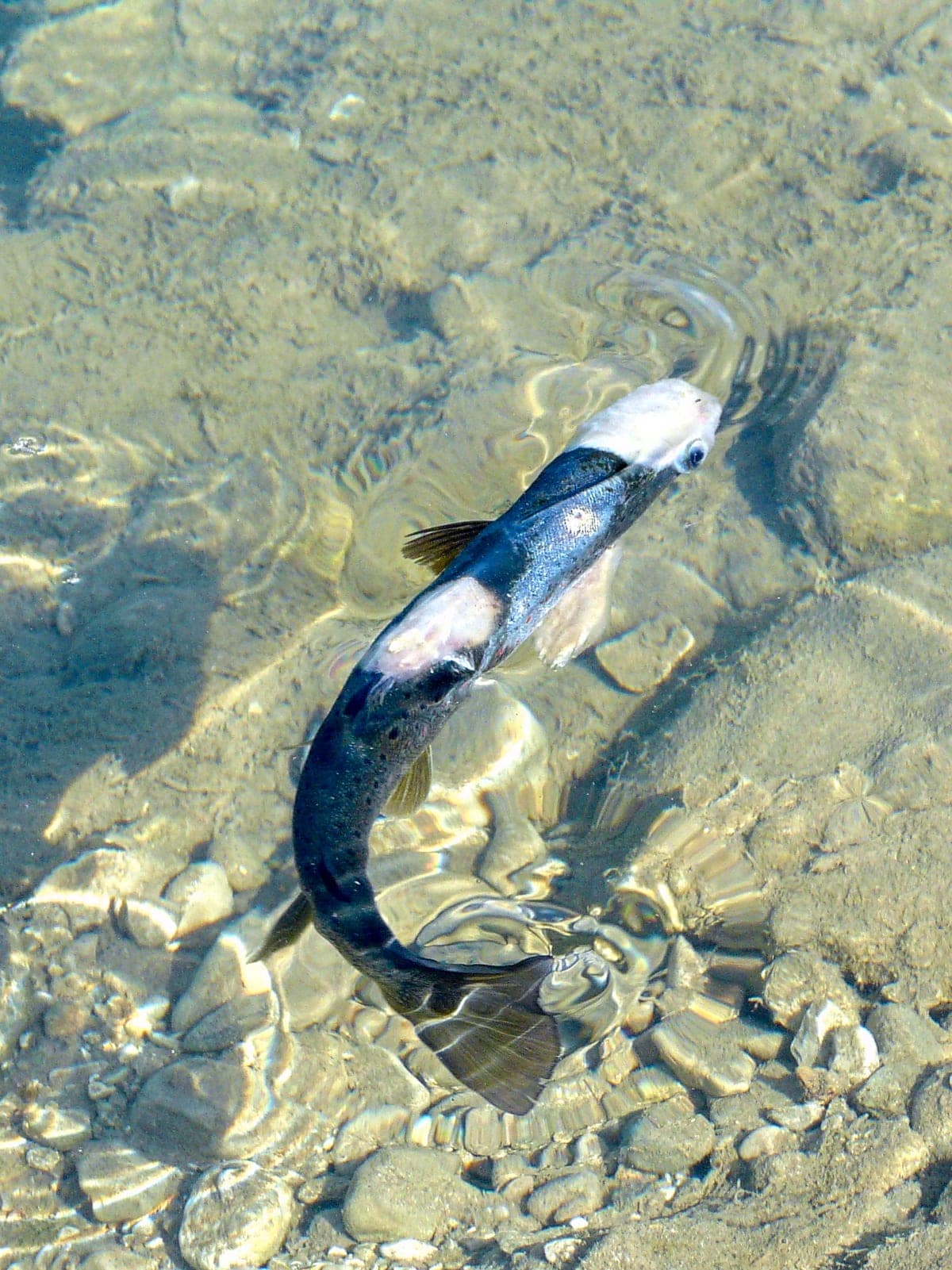
A grey-white tuft like cotton wool rising off the body surface — usually in one place, on a wound, a knocked-off slime layer or dead tissue. It grows and spreads over days. The photo shows a trout with two classic cotton tufts.
How to tell it from its look-alikes
True fungus almost always grows ON something — a wound, an injury, tissue that is already dead — and rises as a three-dimensional tuft. The columnaris film it is most confused with lies flat, is often yellowish, and spreads much faster. Only a microscope separates them for certain, so watch the speed: if the “fungus” spreads within a day, it is probably not fungus.
The dangerous mistake
Seeing the fungus and missing the cause. Saprolegnia is an opportunist — it almost never colonises the intact skin of a healthy fish. Fungus on a fish almost always means something came first: an injury, nipping, bad water, water too cold, or another disease. You can clear the tuft, but without removing the cause it comes back.
Water first
In a young tank, most “disease” is not disease — it is ammonia or nitrite poisoning, and no medicine treats that. Before buying anything, test ammonia, nitrite and nitrate. If you keep the cycle log, the answer is already there.
New tank syndromeWhat to do
Test the water and find the primary cause — without that, any treatment is temporary. Treat with an antifungal ornamental-fish preparation per its label — Lithuanian shops carry them — ideally in a quarantine tank. Correct the temperature if it has drifted below the species' range — chilled fish are the most fungus-prone.
What to expect
A local patch on an otherwise healthy fish, with the cause found and fixed, is curable. Fungus covering a flank or in the gills is a late stage with a poor outlook.
This reference helps you recognise and tell conditions apart — it does not make the diagnosis. Only a microscope or a veterinarian confirms one. Use medicines exactly per the label, ideally in a quarantine tank, because several of them kill filter bacteria.
Sources
- https://www.merckvetmanual.com/exotic-and-laboratory-animals/aquaculture/mycotic-diseases-in-aquaculture
- https://aquaculture.mgcafe.uky.edu/sites/aquaculture.ca.uky.edu/files/srac_4700_saprolegniasis_winter_fungus_and_branchiomycosis_of_commercially_cultured_channel_catfish.pdf
- https://pmc.ncbi.nlm.nih.gov/articles/PMC3648355/