Fin rot
Treat nowBacterial infectionAeromonas, Pseudomonas, Flavobacterium spp.
Also called: Ragged fins, Fin erosion
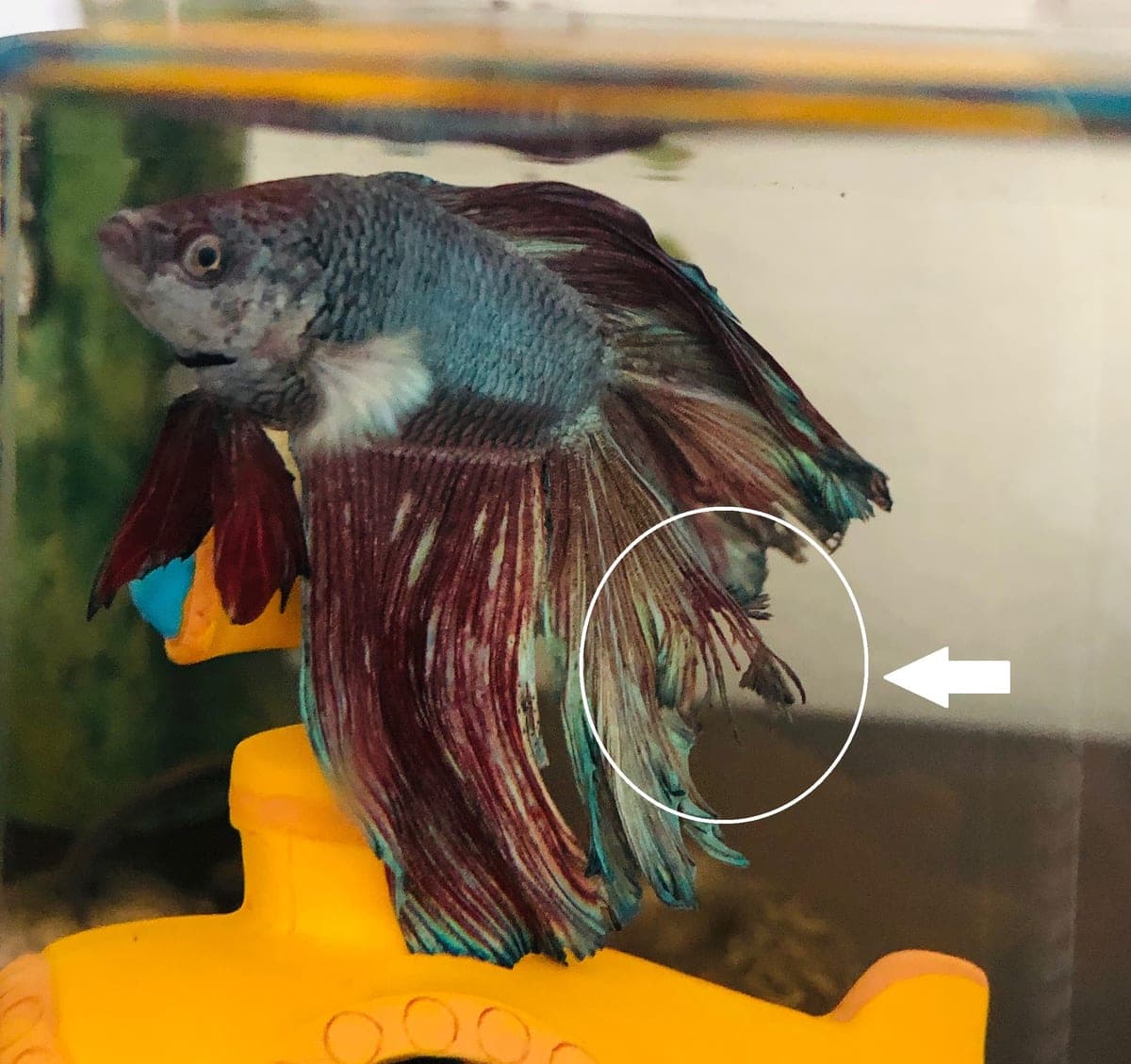
What you see
Fin edges crumble, split and recede, often with a whitish, dark or reddened rim along the eroding line. It starts at the edge and creeps toward the fin base over weeks. The photo shows a betta with a tail beginning to fray, the affected area circled.
How to tell it from its look-alikes
The three common causes leave different tracks. Tankmate nipping — clean, scissor-like notches with no eroding rim, and it continues only while the nipper is present (the planner warns which species nip fins). Bacterial rot — an uneven, crumbling edge with a rim, usually in poor water. And fins going together with slow wasting of the fish points to mycobacteriosis, which likes to impersonate fin rot. Which cause is yours is settled most reliably not by how the fins look but by a water test.
It differs from ich in shape: not discrete round grains but flat, spreading patches. From true fungus it differs three ways: the columnaris film lies flat rather than tufting upward, is often yellowish rather than grey-white, and spreads faster — visibly within a day or two, where fungus takes several days. Only a microscope separates these two for certain — so when in doubt, act as if it were columnaris, the faster and deadlier of the pair.
The separator from dropsy is time and body condition: dropsy is acute bloating on a normal-bodied fish, while mycobacteriosis is slow wasting that swelling, ulcers or deformities join over weeks. It differs from ordinary fin rot in that the fins erode WHILE the whole fish declines, and the water can be spotless.
The dangerous mistake
Dosing medicine before testing the water. Fin rot is usually a consequence of bad water — ammonia and nitrite erode fins and open the door to bacteria, and no medicine fixes water quality. Treating without fixing the water is money into the filter — often literally, since several of these products kill filter bacteria too.
Water first
In a young tank, most “disease” is not disease — it is ammonia or nitrite poisoning, and no medicine treats that. Before buying anything, test ammonia, nitrite and nitrate. If you keep the cycle log, the answer is already there.
New tank syndromeWhat to do
Test ammonia, nitrite and nitrate — if you keep the cycle log, compare against it. Fix the water with changes and remove the cause: separate a nipper, thin an overstocked tank. If erosion continues in good water, treat with an antibacterial preparation (sold in Lithuanian shops, e.g. sera Baktopur), ideally in quarantine. A veterinarian is needed once rot reaches the body.
What to expect
Fins regrow — sometimes slightly changed in shape or colour — if the erosion is stopped before the fin base. Once it reaches the body it becomes a systemic infection with a seriously worse outlook.
This reference helps you recognise and tell conditions apart — it does not make the diagnosis. Only a microscope or a veterinarian confirms one. Use medicines exactly per the label, ideally in a quarantine tank, because several of them kill filter bacteria.