Dropsy
UrgentSignAlso called: Pinecone scales, Ascites, Swollen fish
What you see
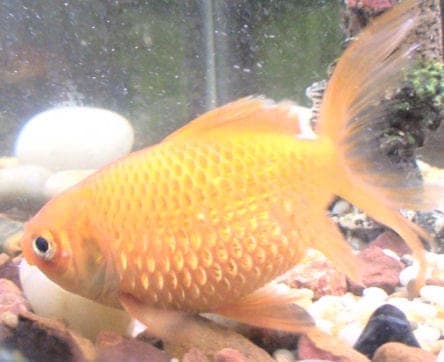
A swollen body with scales standing out — seen from above, the fish looks like a pinecone. Bulging eyes sometimes join it, and the fish turns listless and stops eating. The photo shows a goldfish with its scales lifted off the body.
How to tell it from its look-alikes
The pinecone test from above is the main separator: a swollen belly with FLAT scales is usually overfeeding or a female's eggs, while raised scales mean fluid building up inside — organ failure. If the fish swelled slowly, over weeks, while wasting away — look at mycobacteriosis. A one-sided, slowly growing bulge suggests a tumour instead. Worth knowing: dropsy is a sign, not a disease — many causes produce it, most often a bacterial infection in failing kidneys.
First, the pinecone test from above: if the scales stand out, this is not constipation but dropsy. A symmetrically rounded female behaving normally is most likely just carrying eggs — if she does not spawn, she resorbs them naturally, and that is normal. The “egg-bound fish” that forums worry about so much is, per a board-certified fish veterinarian, a rarity — mostly a fake diagnosis. A one-sided lump growing over weeks is a different story — see the dropsy separators.
The separator from dropsy is time and body condition: dropsy is acute bloating on a normal-bodied fish, while mycobacteriosis is slow wasting that swelling, ulcers or deformities join over weeks. It differs from ordinary fin rot in that the fins erode WHILE the whole fish declines, and the water can be spotless.
The dangerous mistake
Weeks of guessing with medicines. By the time scales pinecone, the kidneys are usually profoundly damaged and no shelf product restores them — and while the sick fish stays in the main tank, the others are at risk. A separate note for Malawi cichlids: refusing food and bloating there is a syndrome with several possible causes, most of which no medicine touches — isolate immediately and do not guess.
Water first
In a young tank, most “disease” is not disease — it is ammonia or nitrite poisoning, and no medicine treats that. Before buying anything, test ammonia, nitrite and nitrate. If you keep the cycle log, the answer is already there.
New tank syndromeWhat to do
Move the fish to quarantine at once and test the main tank's water. In the early stage — while scales are only starting to lift and the fish still eats — an antibacterial preparation labelled for dropsy can be tried (sold in Lithuanian shops, e.g. sera Baktopur). If the fish stops eating and pinecones fully, the humane choice is euthanasia: clove oil, about 0.4 ml per litre of water, first emulsified in warm water and added gradually — leave the fish in the solution at least 30 minutes after all gill movement has stopped, and only then place it in the freezer. A live fish never goes into the freezer or the toilet.
What to expect
Honestly: a fully pineconed fish has a grave outlook — most do not recover, because the kidney damage is already too deep. An early case with an actual diagnosis is sometimes cured, which is why the from-above pinecone check is worth doing early and often.
This reference helps you recognise and tell conditions apart — it does not make the diagnosis. Only a microscope or a veterinarian confirms one. Use medicines exactly per the label, ideally in a quarantine tank, because several of them kill filter bacteria.
Sources
- https://cafishvet.com/fish-health-disease/dropsy-in-freshwater-fish/
- https://drjohnson.com/dropsy-bloater-pinecone-disease-in-koi-goldfish/
- https://www.merckvetmanual.com/all-other-pets/fish/disorders-and-diseases-of-fish
- https://kb.rspca.org.au/categories/companion-animals/fish/what-is-the-most-humane-way-to-euthanase-aquarium-fish
- https://ask.ifas.ufl.edu/vm077