Stream Bogmoss
Mayaca fluviatilis
Mayacaceae
About
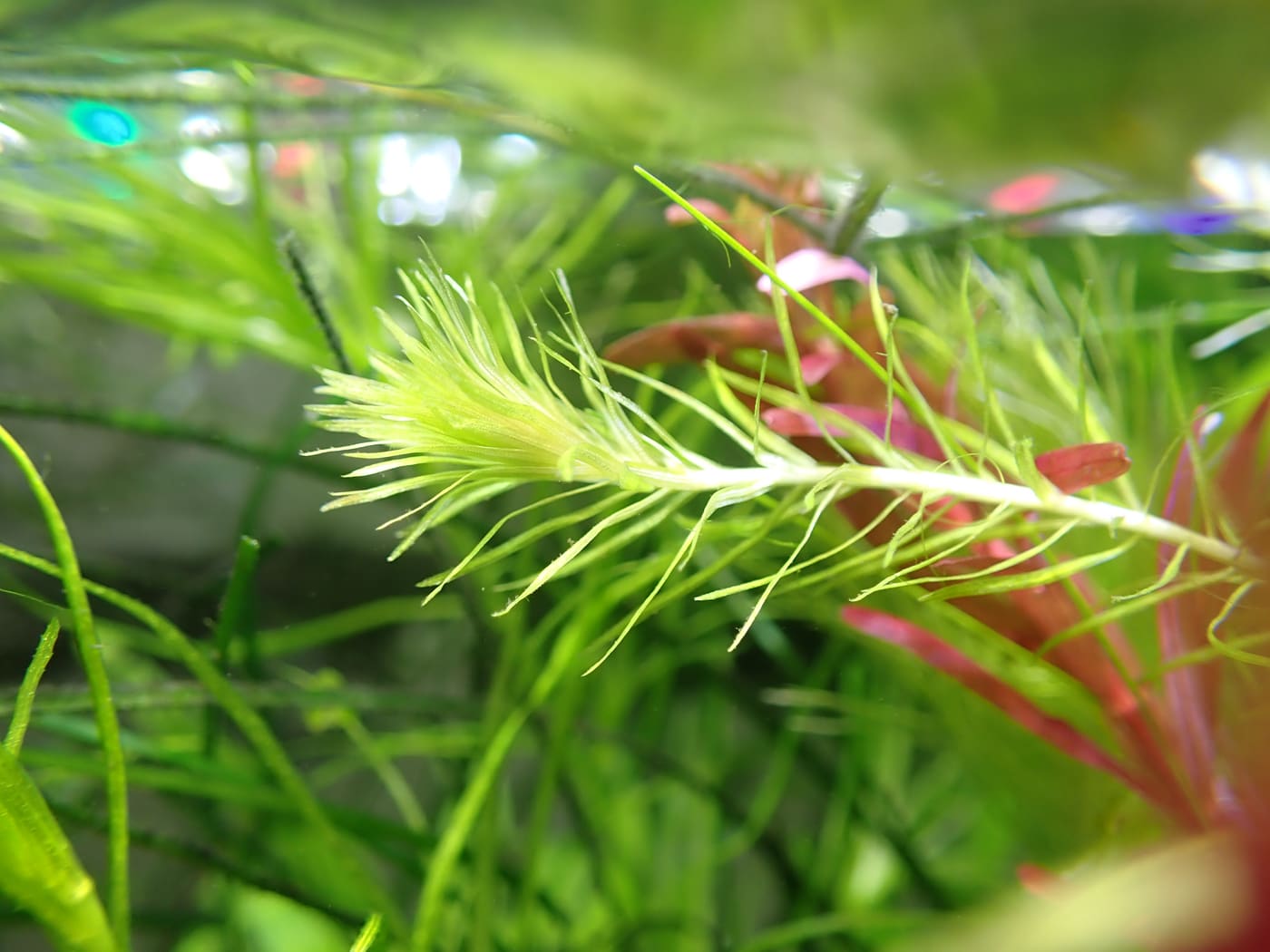
Mayaca fluviatilis is the softest stem plant on most shop shelves: a limp, bright fresh-green shoot densely clothed in tiny needle leaves, one leaf per node. A healthy group looks like a moss that decided to grow upright, which is exactly what the trade names say — stream bogmoss, bog moss, Fluss-Mooskraut. Flowgrow notes the species is variable, with forms differing slightly in their characteristics, and places it at the edges of blackwater streams from the south-eastern USA to Argentina. Established and fed, it grows fast, branches into a feathery cloud and holds the same light green from the tips all the way down to the substrate. That last part is the tell, because everything that goes wrong with this plant shows up as a colour change or a bare gap somewhere along the stem. Its signature failure is iron. Starved of it, the shoot tips fade to a very pale, almost whitish green while the older growth stays normal; Flowgrow states plainly that dosing iron reverses this immediately, and Tropica and Aquasabi describe the same behaviour. In practice the plant works as a live iron test strip in the tank. Note which way the conditional colour runs here: unlike Ludwigia or Rotala wallichii, Mayaca has no light-driven red to chase, so it stays green under the brightest light you can give it. Whitening tips are not a variety and not a lighting effect — they are a deficiency, and they are fixable in days. The failure the care sheets skip is the first month. Bunched and potted stock is usually raised emersed, and what you buy is not what you keep. A keeper account on the Aquarium Co-Op forum has it seven weeks into a seven-week-old tank with the new growth “slow and some of it has stagnated” and “most of the original growth has browned out and is growing algae” — and a needle-leaved shoot cannot be picked clean of algae the way an Anubias leaf can. That tank recovered about three weeks later, not by rescuing those stems but by waiting until there was enough clean new growth to cut and replant, then giving up on the originals. Budget a month before “fast growth” means anything, and start it in a mature tank if you have one. Light and CO2 are where the published ratings disagree, and this profile now resolves them the demanding way. Flowgrow — our primary — rates light “mittel bis hoch” and ends its description with “Auch benötigt sie ausreichende Mengen an CO2 sowie eine gute Beleuchtung”: it requires adequate CO2 as well as good lighting, and the figure it prescribes, 25-40 mg/l, is a fully injected tank rather than a trickle. Aquasabi prints CO2 “yes”, and the Polish retail sheet says the plant prefers strong light. Against that, Tropica prints a plain Medium for both light and CO2, and Aquasabi prints Medium light — but Aquasabi is Flowgrow's own shop rather than an independent second opinion, so the Medium side of the argument is really Tropica alone. We record high light and CO2 required, and flag the conflict instead of splitting the difference. The difference is not academic: in genuinely low light the plant stretches and gets leggy, and in one keeper's words, “I've never had it grow successfully during low light”; in a group planted too densely the lower stems yellow, shed their leaves and melt away at the base while the tops still look fine. Plant single stems individually rather than as a tied bundle, leave clear water between them and trim often. Short of CO2 or nutrients it simply stalls: the bush loses its dense lush look and sheds from the bottom up, without changing leaf form or melting wholesale. It also dislikes stagnant corners and dirty water. Water chemistry is the forgiving part. Every source describes soft, slightly acidic water as the preference, and Flowgrow places the plant at blackwater stream margins — but Flowgrow also writes that it “lässt sich aber auch in härterem Wasser halten” (can also be kept in harder water), and Tropica says outright that it “also thrives well in medium hard water”. Aquasabi is the only source publishing a general hardness number at all, 0-30 dGH, and that band is the tolerance those words describe rather than a target. In the shop, the confusion is Mayaca sellowiana, whose shoots Flowgrow describes as more compact and more densely leaved than those of fluviatilis. The real trap is that Rotala sp. 'Nanjenshan' was traded for years under the false name 'Mayaca sellowiana'. Settle it at the node: every Mayaca carries alternate leaves, one per node and held close to the stem, while Rotala 'Nanjenshan' carries whorls of several. Rotala wallichii passes for it at a distance too, but reddens under strong light where Mayaca never does. Two caveats on the numbers. Height is contested: Tropica says 15-30+ cm, Aquasabi up to 60, the Polish retail sheet 40-50; we record 40 cm as what a maintained group actually reaches before it runs along the surface. And no database publishes a PAR figure for this plant at all, so our 45-100 band is our own reading of a high-light rating rather than a citation. Finally, Tropica warns that its bunched (non-in-vitro) portions are not grown in its own nursery and cannot be guaranteed free of pesticides: quarantine them two weeks with twice-weekly water changes before they go into a tank with shrimp or sensitive fish.
Care
Treat this as a high-light, CO2-injected stem plant rather than a beginner filler. Flowgrow, the fullest entry on it, says it needs adequate CO2 (25-40 mg/l) and good lighting, and only Tropica rates both plainly Medium. Plant ten or more single stems individually — never as a tied bundle — with clear water between them, under roughly 45-100 PAR: the light is not for colour, it is what keeps the shaded lower stems from yellowing and melting. Dose a complete water-column fertiliser that contains iron, because pale, whitish shoot tips mean iron rather than lighting and correct within days. Expect the first month to look like failure: emersed-grown stock often browns and picks up algae before it converts, and the cure is to harvest clean new tips, replant those and give up on the original stems. Soft, slightly acidic water suits it best (pH 4.5-7, KH 0-6) at 18-30 °C, best around 23-25, though Flowgrow and Tropica both say harder water is workable. Give it gentle to moderate flow and clean water rather than a stagnant corner, top and replant every couple of weeks to keep the group dense, and expect cichlids, goldfish and hungry snails to shred the soft foliage.
Diet
Feeds from both the water column and its roots, but the water column is where it reports problems: iron is the one nutrient it announces visibly, with pale, whitish shoot tips that recover almost as soon as iron is dosed, while nitrate, phosphate and potassium shortfalls show up instead as stalled growth and leaf loss from the bottom of the stem. Flowgrow's targets are NO3 10-50, PO4 0.1-3, K 5-30 and Fe 0.01-0.5 mg/l, and it stresses that a good nutrient balance — not a big dose of any one element — is what this plant is sensitive to.
Frequently asked questions
- What water parameters does a Stream Bogmoss need?
- Stream Bogmoss does best at 18–30 °C (64.4–86 °F), pH 4.5–7 and a general hardness of 0–30 °dGH.
- Where should Stream Bogmoss be placed in the aquarium?
- Stream Bogmoss works best at the back of the tank and reaches around 40 cm.
- Is the Stream Bogmoss suitable for beginners?
- Stream Bogmoss is a demanding species best attempted with some experience — it needs stable, closely watched conditions to thrive.
Sources
- Mayaca fluviatilis - Fluss-Mooskraut - Flowgrow Wasserpflanzen-Datenbank
- Mayaca fluviatilis | Aquasabi - Aquascaping Shop
- Mayaca fluviatilis (140 BDT) - Tropica Aquarium Plants
- Mayaca fluviatilis troubleshooting - Aquarium Co-Op Forum
- Mayaca sellowiana - Flowgrow Aquatic Plant Database (EN)
- Mayaca fluviatilis - Majaka rzeczna - ALIZOO
- Will mayaca fluviatilis do fine in low light? - The Planted Tank Forum
- Magnolijūnai - Vikipedija (šeima Mayacaceae)