Mermaid Weed
Proserpinaca palustris
Haloragaceae
About
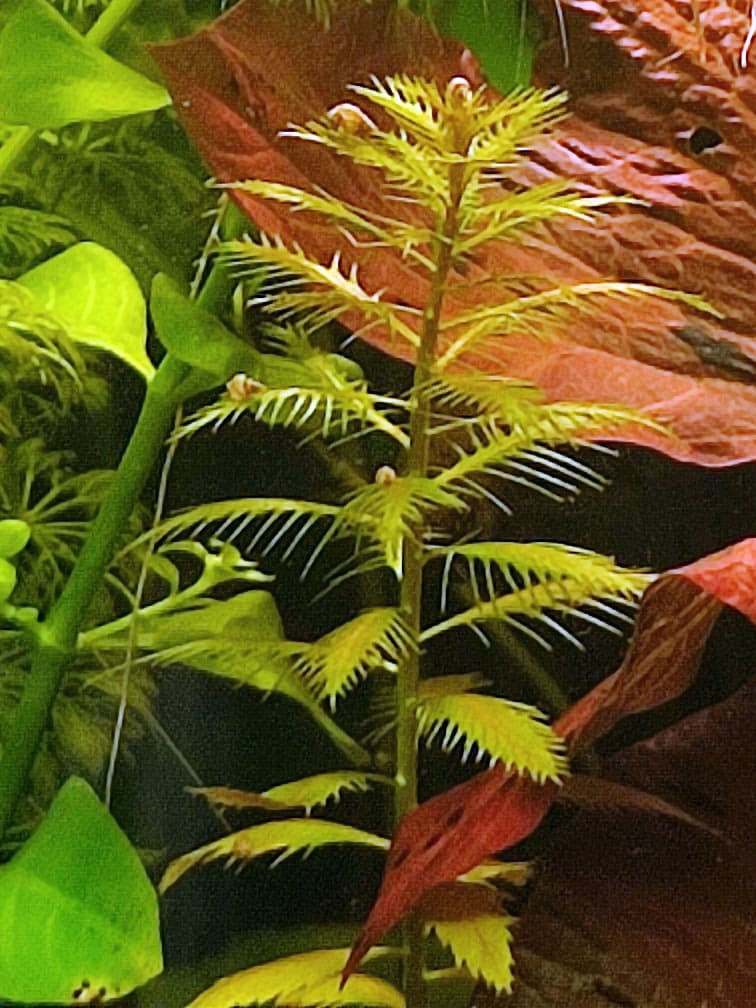
Mermaid weed leaves the lab cup looking nothing like the catalogue photo, and that single fact explains most of the disappointment around it. Tissue-culture and emersed stock carries broad, simply saw-toothed green leaves; the plant it is actually sold for — needle-fine, comb-cut leaves in copper, orange and burnt red, set singly and alternately up a stiff stem — appears only after it has grown a fresh set of leaves under water. No source will name a week count for that changeover, and impatient buyers pull it out before it happens. A happy specimen has short internodes, colour running right to the growing tip, and no bare stalk at the bottom. The red is governed by fertiliser rather than lamps: nitrate much above 10 mg/l turns it pale orange and then green no matter how bright the light, while the deep orange-red comes from holding nitrate down at 5-10 mg/l with phosphate up at 1.5-2 mg/l and iron dosed without gaps — let iron lapse and the colour simply fades out. Without injected CO2 the colour never arrives at all; the stem usually survives but stays thin and green, which is why the plant is so often reported as alive and entirely pointless. When conditions are not met it fails in specific, recognisable ways. It melts after the emersed-to-submersed switch, after sudden parameter swings, and in hard alkaline water. Weak light or a short photoperiod strips the lower leaves and leaves a bare stalk. An underfed plant sheds leaves generally and pushes unsightly aerial roots out along the stem. Because it grows slowly, none of this repairs itself quickly: a bare or melted stem takes months to rebuild and the plant will never outgrow an algae problem. There is also one failure with no fix on record — a documented Flowgrow case had the 'Cuba' clone throwing stunted, twisted tips across every stem at NO3 10-15 mg/l, PO4 1.8 mg/l, Fe 0.01 mg/l and CO2 20-30 mg/l but GH 16 and KH 14, and the moderator's verdict was that this is one of the growth forms of a very variable species rather than a deficiency, with no trigger ever identified, so it is not something to answer with more fertiliser. Several requirements here are genuinely contested and the harder reading has been taken for each: Flowgrow and Dennerle call it medium difficulty and Flowgrow even says it is not too hard to keep, while Tropica rates it Advanced and Aquasabi Difficult; the nursery growth-rate fields say medium, but Dennerle's own body text, Flowgrow's English entry and both independent care guides describe it as slow; and on hardness Aquasabi publishes 0-30 °dGH where every other source demands very soft to medium water, with Go Botany recording the wild plant in shallow, basic to circumneutral marsh water — the aquarium evidence, the stunted GH 16 case included, points at soft acidic water and that is what is listed here. In the shop it is mistaken for Limnophila aromatica in the emersed state; the decisive tell needs no tools, because Proserpinaca sets its leaves one at a time and alternately, while Limnophila sets them in opposite pairs or whorls. Proserpinaca pectinata, the other genus member occasionally sold, is feathery in both its forms.
Care
Injected CO2 of roughly 20-30 mg/l, strong light and soft acidic water are the entry price — this is not a beginner stem plant, and two of the four big nurseries rate it advanced or difficult. Without CO2 it stays thin and green instead of colouring up. Steer the colour with fertiliser, not the lamp: nitrate at 5-10 mg/l, phosphate at 1.5-2 mg/l, iron every week without a break. Expect several plain green weeks after planting while the emersed leaves are replaced; that is the transition, not a failure. It grows slowly and barely branches, so cut the head, replant it in the same hole and discard the old lower stem — and count on months, not weeks, to rebuild a stem that has melted or gone bare. A rich aquasoil that leaks nitrate works against the red.
Frequently asked questions
- What water parameters does a Mermaid Weed need?
- Mermaid Weed does best at 10–28 °C (50–82.4 °F), pH 5–7.5 and a general hardness of 1–12 °dGH.
- Where should Mermaid Weed be placed in the aquarium?
- Mermaid Weed works best in the midground and reaches around 40 cm.
- Is the Mermaid Weed suitable for beginners?
- Mermaid Weed is a demanding species best attempted with some experience — it needs stable, closely watched conditions to thrive.
Sources
- Proserpinaca palustris - Amerikanisches Kammblatt - Flowgrow Wasserpflanzen-Datenbank (PRIMARY)
- Proserpinaca palustris - Mermaid weed - Flowgrow Aquatic Plant Database (English mirror)
- Proserpinaca palustris 'Cuba' - Tropica Aquarium Plants
- Proserpinaca palustris 'Cuba' | Aquasabi - Aquascaping Shop
- Proserpinaca palustris - Dennerle Plants
- Proserpinaca Palustris 'Cuba' Mangelerscheinung / Krüppelwuchs - Flowgrow forum thread 49023
- Mermaid Weed Care Guide - Planting, Growing, and Propagation | Shrimp and Snail Breeder
- Proserpinaca pectinata - Flowgrow Wasserpflanzen-Datenbank
- Proserpinaca palustris (marsh mermaid-weed) - Go Botany, Native Plant Trust
- Proserpinaca palustris - Wikipedia
- Proserpinaca: photoperiodic and chemical differentiation of leaf development and flowering (Davis 1967) - PubMed 16656552
- Chromosome-level genome of Proserpinaca palustris reveals key KNOX genes related to heterophylly formation - BMC Plant Biology (2025), open-access mirror
- Proserpinaca palustris (Mermaid Weed) - Care, Propagation & Growth Tips | aqua-fish.net
- Proserpinaca Palustris Care Guide - The Aquarium Guide