Japanese Cress
Cardamine lyrata
Brassicaceae
About
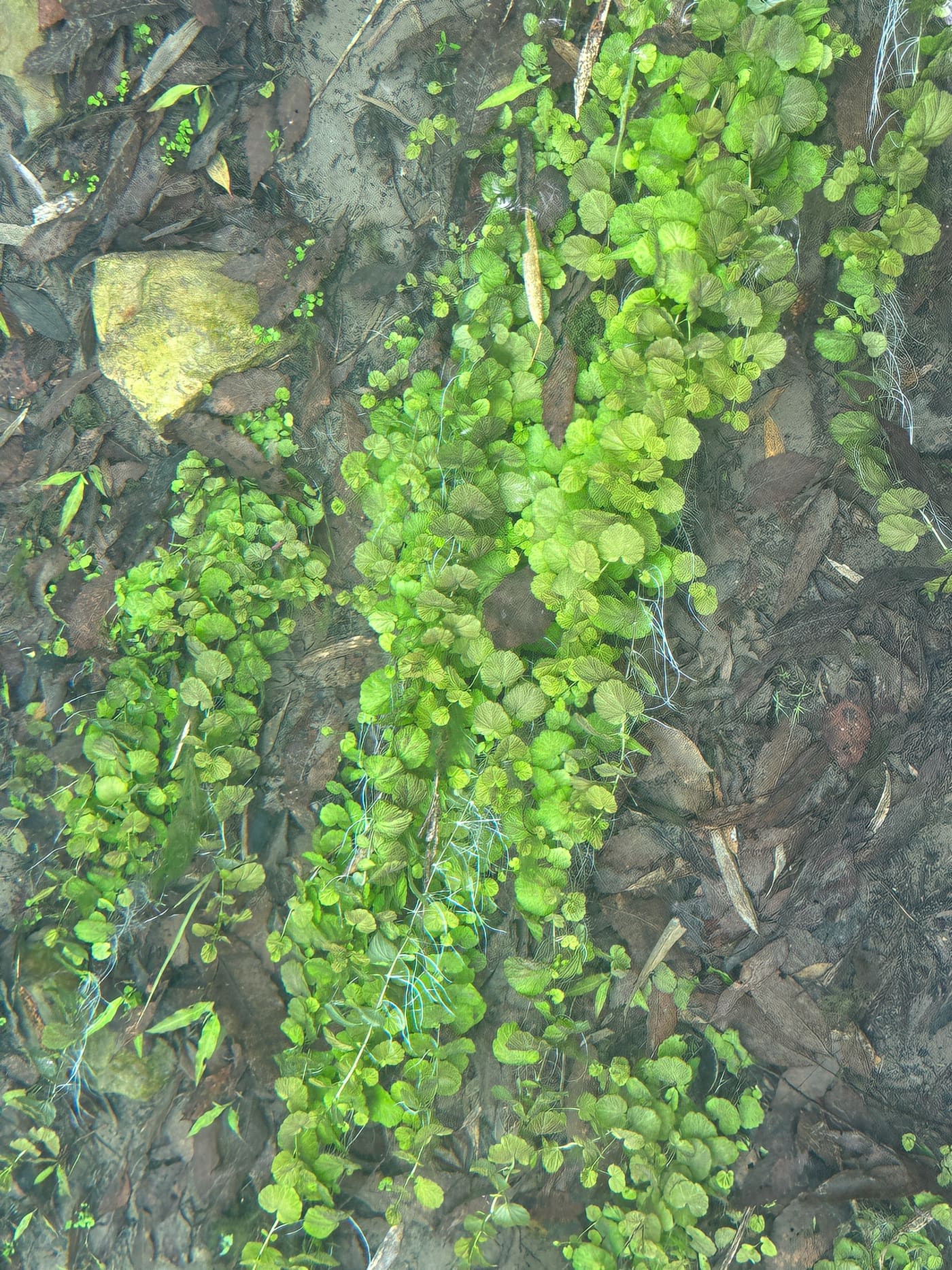
Japanese cress is sold on the tropical plant rack and does not belong there: it is a genuinely cold-water species from China, Japan, Korea and the Russian Far East, hardy enough to overwinter outdoors in Central Europe. The epithet lyrata comes from the lyre-shaped pinnate leaves it makes above water; submersed it looks nothing like that. It creeps rather than climbs, throwing thin zig-zag stems hung with kidney-shaped leaves 1-2 cm across, each leaf stalk joining at the notch on the leaf edge. That attachment point is the fastest way to separate it from Brazilian pennywort (Hydrocotyle leucocephala), the plant it is most often confused with in shops, whose rounder, fleshier leaf meets its stalk near the centre. The mix-up matters more than the botany: Hydrocotyle is happiest at 20-28 C, Cardamine at 18-23 C, so in the same 26 C community tank one thrives while the other slowly dies. A happy plant carries broad round leaves on short internodes with thick stems and white roots at the nodes. Too warm, and it fails in a slow, recognisable sequence - new leaves come in progressively smaller, internodes stretch, lower leaves drop, and finally the bare stems melt, usually over weeks to months, which is why keepers blame algae or fertiliser instead of the heater. A second, much faster failure looks different and is routinely mistaken for the first: potted stock is grown emersed, and in the first two or three weeks after planting the old leaves can go holey and then dissolve outright, sometimes all of them. That is the conversion melt - it hits early, it takes only the leaves that arrived with the plant, and the stems stay firm. Leave those bare stems planted and new submersed leaves push from the nodes; pull them out and you have thrown away a plant that was working. How much light it wants is genuinely contested: Tropica rates the demand low, Flowgrow medium to high, and both Diszhal and aqua-fish simply say bright. We publish medium and the tell rather than the label - under roughly 0.5 W per litre the stems go thin and wiry while the leaves stay small, so dim light shrinks the foliage too, and stem thickness is what separates a light problem from a heat problem. Untopped stems run to 50 cm and then flop over whatever is in front of them, which is why this is filed as a background plant; topped every two or three weeks it will hold a midground group or trail forward as a loose mat. There is no red form to lose here: the catalogue photo of big rounded foliage is a cool-tank photo, not a fertiliser photo.
Care
Keep it under 24 C. This is one of the few trade plants for an unheated room-temperature tank, and a standard 25-26 C tropical setup is already too warm - the LT shops selling it print a 27 C ceiling and no warning at all. Push 10-15 cm cuttings into the substrate in small groups at the back or along the sides; stems reach 50 cm and flop, so top them every two or three weeks if you want them holding a midground line or running forward as a creeping mat. CO2 is optional, but give it at least moderate light (roughly 0.5 W per litre and up) or the stems go wiry. Potted stock is grown emersed and usually sheds those first leaves after planting, sometimes going holey and dissolving within a fortnight - leave the bare stems in place, they reshoot from the nodes. In a cold tank watch the stock: goldfish shred it. We rate it 3 where the shops say easy, for one reason: the plant itself is undemanding, but the temperature limit is not negotiable and most community tanks sit above it.
Diet
Feeds mainly from the water column but also roots at every node, so a modest column dose of nitrate, potassium and iron is enough; it grows fast without CO2 and faster with it.
Frequently asked questions
- What water parameters does a Japanese Cress need?
- Japanese Cress does best at 4–24 °C (39.2–75.2 °F), pH 5–8 and a general hardness of 4–30 °dGH.
- Where should Japanese Cress be placed in the aquarium?
- Japanese Cress works best at the back of the tank and reaches around 50 cm.
- Is the Japanese Cress suitable for beginners?
- Japanese Cress sits in the middle of the difficulty scale — manageable for a careful beginner who has done the reading, but it has specific needs worth researching first.
Sources
- Cardamine lyrata - Japanisches Schaumkraut - Flowgrow Wasserpflanzen-Datenbank
- Cardamine lyrata (024) - Tropica Aquarium Plants
- Cardamine lyrata | Aquasabi - Aquascaping Shop
- Hydrocotyle leucocephala - Brasilianischer Wassernabel - Flowgrow Wasserpflanzen-Datenbank
- Cardamine lyrata in Flora of China (FOC Vol. 8 p. 98) - efloras.org
- Characterization of the complete chloroplast genome sequence of Cardamine lyrata Bunge (Brassicaceae)
- Cardamine lyrata - Chinese ivy, Japanese cress | Diszhal.info
- Growing and Caring for Cardamine Lyrata - aqua-fish.net
- Cardamine lyrata loest sich auf - Flowgrow first-aid thread
- Cardamine lyrata - Geraszoo.lt / aquauga.lt (Lithuanian shop listing)
- Kartene (Cardamine) - Visuotine lietuviu enciklopedija (VLE)