Cryptocoryne Undulata
Cryptocoryne undulata
Araceae
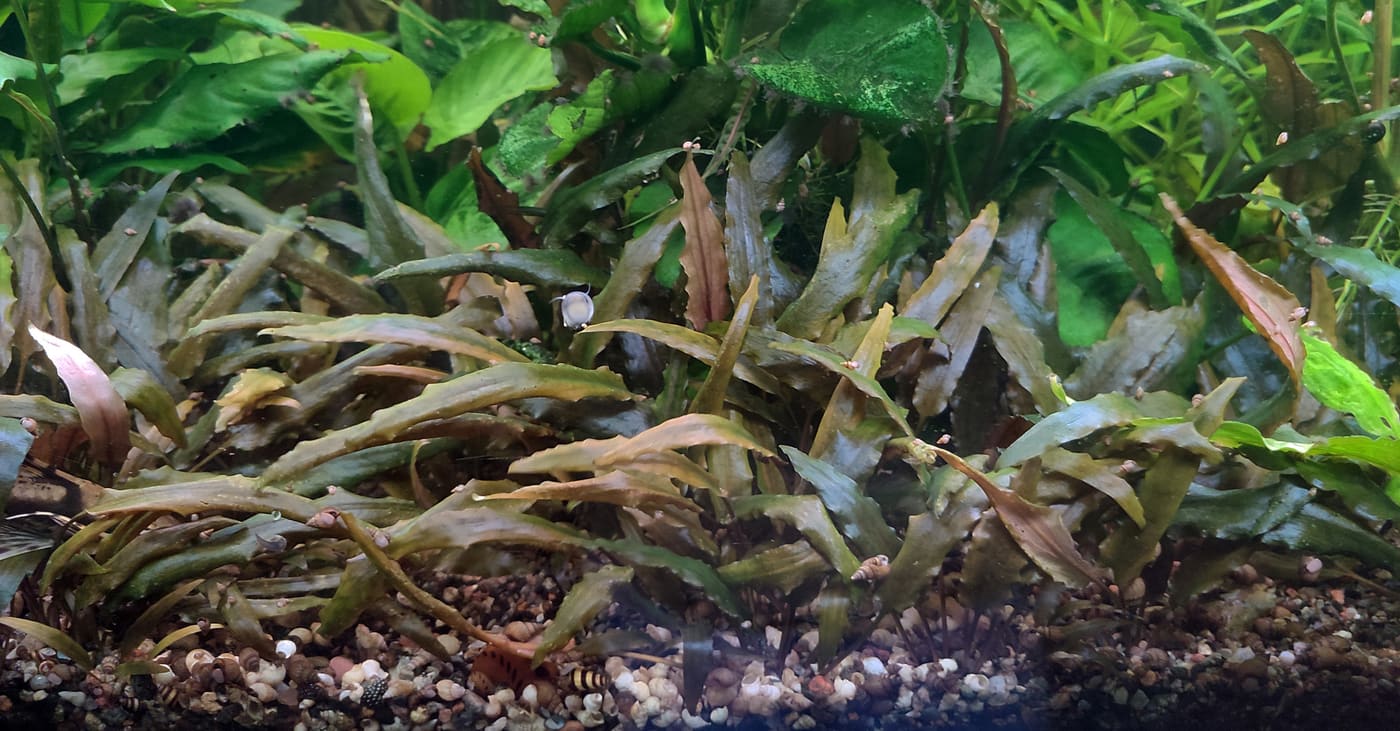
About
Cryptocoryne undulata is the wavy-edged member of the Sri Lankan wendtii group, a midground rosette from the central highland streams around Kandy. A settled plant carries narrow, lance-shaped blades up to about 3 cm wide on long petioles, with a margin that ripples along the whole length of the leaf, and the underside is picked out in red veins against a paler blade. That vein pattern is the practical shop test — but treat it as a hint, not proof. The sources contradict each other on leaf shape (the German and Dutch references call undulata the narrow one and wendtii the broad one; Fish Laboratory says the exact reverse), triploid plants look intermediate between C. beckettii and C. walkeri, and Bastmeijer's monograph is explicit that certain identification needs the inflorescence. Against the other crypts on the same shelf: C. usteriana is twice the size at 40–70 cm with a deeply embossed, hammered blade and belongs at the back; C. wendtii is broader, its surface puckered while the edge stays comparatively straight, and its tip is blunter; C. beckettii is a broader ovate-lanceolate leaf with a rounded base, only finely fluted right at the edge, and its underside is a flat violet wash rather than veins drawn in red; C. walkeri is narrower and greener with an almost flat margin; C. parva is a 6 cm foreground tuft nothing else resembles. At the tank it is two moves: run a finger along one leaf edge — undulata ripples for the whole length, while wendtii and usteriana are puckered across the blade but comparatively straight-edged — then turn a leaf over and check whether the veins are drawn in red or the whole underside is flushed evenly. Treat the catalogue photo as conditional. The compact, reddish-brown plant in the picture was grown under strong light, a rich substrate and added CO2; in an unfertilised low-light tank the same plant does not fail, it re-shapes — slower, greenish-brown, and pushing to the top of every published band at around 30 cm rather than the 15–25 cm on the label, because low light makes this crypt stretch rather than stunt. Plan for that: in a shallow tank a stretched specimen stops reading as midground and starts reading as background. Expect one melt after purchase or after any abrupt change to light, dosing or CO2: leaves go mushy and dissolve within days, but the rhizome stays alive and pushes tank-adapted leaves in one to three weeks, so leave it in the substrate and cut the mush away so it does not rot in place. The way to avoid a second melt is to change one thing at a time — replace tubes one at a time rather than the whole fixture at once. The one thing that genuinely kills it is being dug up and replanted repeatedly. In an old clump the rhizome creeps out of the substrate by itself; that is this species ageing, not disease — press it back down instead of throwing the plant away. In the shop it appears as 'undulatus' (a masculine misspelling in near-universal trade use), as the old name axelrodii, and as two cultivars — the triploid 'Broad Leaf' is broader and barely wavy, so buy 'Red' if the ripple is what you want. Older books call this plant Cryptocoryne willisii; do not carry that name into a shop today. Cryptocoryne × willisii Reitz is a separate accepted plant still in the trade — a natural hybrid of C. parva and C. walkeri, usually sold as 'nevillii' — and it is a low carpeting plant, not a 30 cm rosette. Plant small portions three to five centimetres apart and let the runners close the gaps; in an unfertilised tank that takes months, not weeks.
Care
Plant small portions 3–5 cm apart in a nutrient substrate with root tabs, then stop touching it: it takes almost any water chemistry (pH 5–8, KH 1–18, no CO2 needed) but rots if uprooted twice. Low light keeps it alive; strong light, iron and CO2 are what make it short and red-brown instead of tall and greenish. A melt after purchase is normal — trim the mush, leave the rhizome, wait 1–3 weeks, and afterwards change only one thing at a time.
Diet
A root feeder first: keep a nutritive substrate or push root tabs under the rhizome and renew them, because a settled clump strips a tab within a few months. It survives unfertilised water, but iron and a full trace mix in the water column are what turn the leaves red-brown instead of green.
Also in these lists
Frequently asked questions
- What water parameters does a Cryptocoryne Undulata need?
- Cryptocoryne Undulata does best at 15–28 °C (59–82.4 °F), pH 5–8 and a general hardness of 2–25 °dGH.
- Where should Cryptocoryne Undulata be placed in the aquarium?
- Cryptocoryne Undulata works best in the midground and reaches around 30 cm.
- Is the Cryptocoryne Undulata suitable for beginners?
- Yes — Cryptocoryne Undulata is one of the easier species to keep and forgives typical first-tank mistakes, as long as the aquarium is cycled and maintained.
Sources
- Cryptocoryne undulata – Gewellter Wasserkelch, Flowgrow Wasserpflanzen-Datenbank
- Cryptocoryne undulata 'Broad Leaves' – Breitblaettriger Gewellter Wasserkelch, Flowgrow
- Cryptocoryne undulatus 'Red' (110B-TC) – Tropica Aquarium Plants
- Cryptocoryne undulata 'Broad Leaf' (110A) – Tropica Aquarium Plants
- Cryptocoryne undulata ('axelrodii') – Aquasabi
- C. undulata – The Crypts pages, Jan D. Bastmeijer (cryptocoryneworld.org)
- Cryptocoryne × willisii "nevillii" – Flowgrow Aquatic Plant Database
- Cryptocoryne 'Melt' – Florida Aquatic Nurseries
- Cryptocoryne Undulata Care Guide – Fish Laboratory
- Cryptocoryne undulatus Red (Broad Leaf) – Tropica 1-2 Grow!, Aquarium Gardens
- Der Gewelltblaettrige Wasserkelch – Cryptocoryne undulata, aquarium-ratgeber.com
- Cryptocoryne undulata – Wikipedia