Cryptocoryne Albida
Cryptocoryne albida
Araceae
About
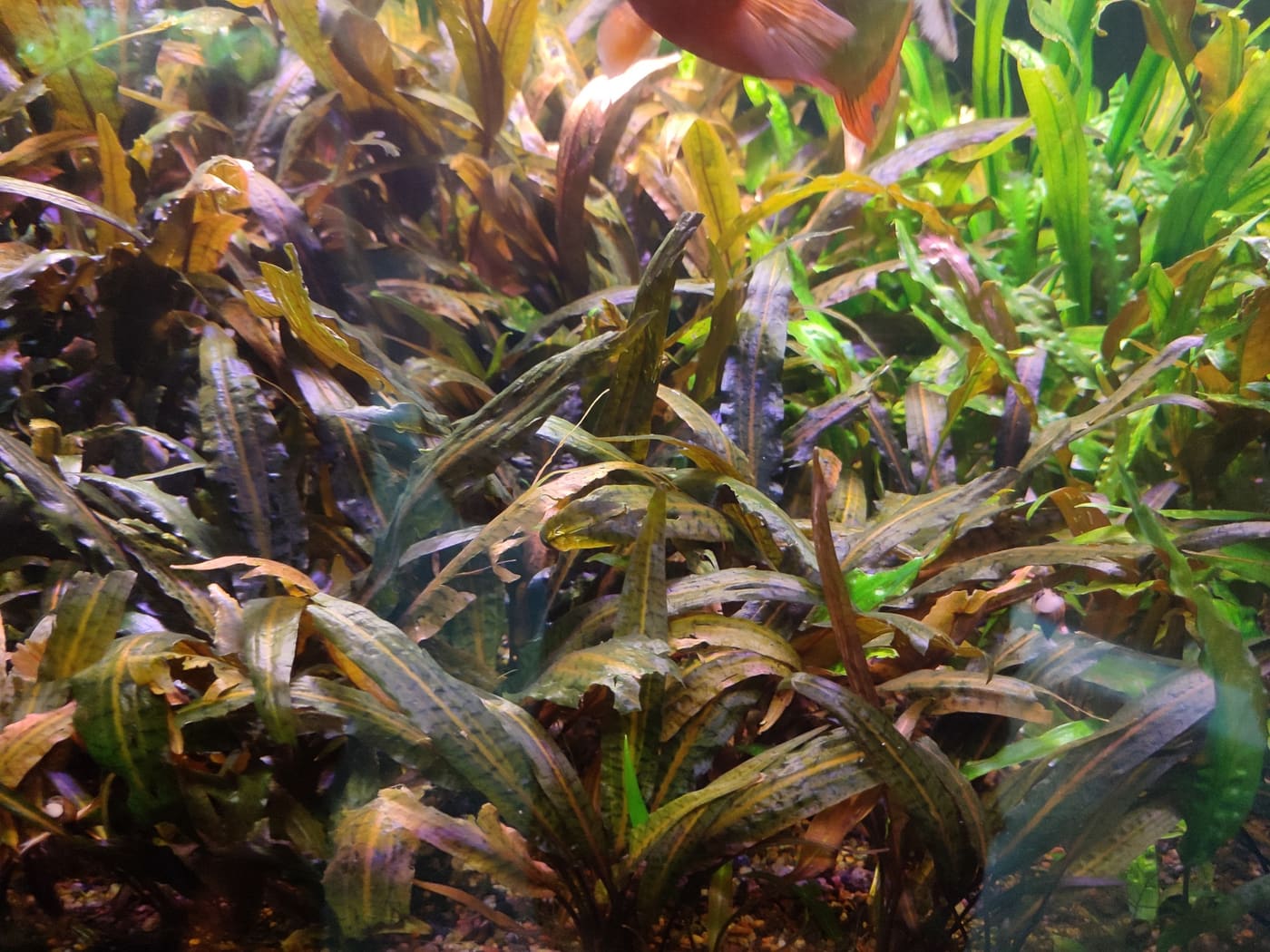
Cryptocoryne albida is the narrow-leaved crypt of the crispatula group, from southern Myanmar and Thailand, where Aquasabi's German sheet records it growing on and in flowing waters. A settled plant is a low rosette of very narrow lanceolate blades — 1–3 cm wide, up to 15 cm long — held on distinct petioles, flat with slightly undulating margins. Height is the first thing to get right: Tropica lists 5–15+ cm, Aquasabi recommends a care height of 10–20 cm, and aqua-fish.net reports up to 30 cm reached under cultivation, so plan for a midground plant that may not stay small. Colour is the second. Flowgrow is explicit that this is a highly variable species whose green and brownish forms occur in the same wild populations, so the red-brown blade with black stripes and flecks is a property of the form or clone you bought, not a reward for lighting: Tropica's selected 'Brown' (126B) already arrives brown, plants shipped as 'costata' are usually the green form, and Florida Aquatic Nurseries describes the ordinary submersed plant as plain olive green. Light modulates what you already have — aqua-fish.net notes higher intensity may deepen the reddish-brown of some varieties while lower light gives greener leaves — but no amount of light turns a green clone red. Its closest relative in this catalogue is the balansae crypt (since 2022 albida is formally Cryptocoryne crispatula var. albida), and there is no confusing them in a tank: balansae is a 40–60 cm background plant with long, strap-like, usually hammered leaves, while albida is a short, flat-bladed midground plant. C. parva is a tiny plain-green carpet tuft and C. usteriana a giant bullate hard-water crypt, so neither overlaps; against the broader Sri Lankan crypts — wendtii, beckettii, walkeri and undulata — the narrow blade is the separator, though inside the crispatula complex itself the taxonomists' own position is that sharp boundaries between the varieties cannot be drawn. Expect to lose the pot foliage: emersed-grown nursery leaves die back after planting and are replaced by submersed ones, and aqua-fish.net is explicit that this species is prone to crypt melt while it adjusts to a new tank — the file's headline failure mode, not an afterthought. Then leave it alone. An old guide puts it bluntly: 'A slow grower, C. albida doesn't move well at all, but with suitable lighting and a good substrate, it should grow well' — and the same guide blames changes in light intensity for melt as well, so do not re-aim the lamp at it either. Difficulty is genuinely contested: four nursery and shop sheets call it easy, while Florida Aquatic Nurseries calls it one of the more difficult species to maintain in the aquarium and aqua-fish.net rates it moderate and 'not as hardy as some other Cryptocoryne species'. Light is contested the same way — most trade sheets say low demand, aqua-fish.net says bright — and Tropica's own note resolves the two honestly: it survives even very poor light, but then grows only very slowly. One last trap: at this growth rate surplus light ends up on the leaves rather than in them, and aqua-fish.net warns that excessive light encourages algae on the blades. CO2 is not required; injection simply makes a very slow plant fill in faster and denser.
Care
Plant it once in a nutrient-rich substrate with a root tab and then never move it: this crypt melts both when transplanted and while it settles into a new tank, and at its growth rate one setback costs months. Water chemistry is forgiving (pH 5–8, KH 2–12), but light is contested — most trade sheets say low demand while aqua-fish.net says bright, and in a dim tank the plant merely survives and stalls. The red-brown striping depends on which form you bought, not on how hard you light it. CO2 is optional.
Diet
A root feeder: a nutrient-rich substrate or a root tab pushed under the rosette does more than any water-column dosing, and Florida Aquatic Nurseries adds that soft water gives better results. It grows without added CO2 or fertiliser, only very slowly; light regular column dosing with iron and traces supports denser growth and, on a brown-form plant, its colour.
Frequently asked questions
- What water parameters does a Cryptocoryne Albida need?
- Cryptocoryne Albida does best at 6–30 °C (42.8–86 °F), pH 5–8 and a general hardness of 2–18 °dGH.
- Where should Cryptocoryne Albida be placed in the aquarium?
- Cryptocoryne Albida works best in the midground and reaches around 30 cm.
- Is the Cryptocoryne Albida suitable for beginners?
- Cryptocoryne Albida sits in the middle of the difficulty scale — manageable for a careful beginner who has done the reading, but it has specific needs worth researching first.
Sources
- Flowgrow Aquatic Plant Database – Cryptocoryne albida (White water trumpet)
- Aquasabi – Cryptocoryne albida ("costata")
- Aquasabi (DE) – Cryptocoryne albida ("costata") / Weißlicher Wasserkelch
- Tropica – Cryptocoryne albida 'Brown' (126B)
- Aquarium Gardens – Cryptocoryne albida Brown
- Aquasabi – Cryptocoryne albida 'Brown' – Pot
- Flowgrow forum – C. albida reclassified as C. crispatula var. albida
- Flowgrow forum – Unterschied C. costata vs C. albida 'Brown'
- Aqua-Fish.net – Cryptocoryne albida care guide
- Florida Aquatic Nurseries – Cryptocoryne albida
- AquaticCommunity – Cryptocoryne: A How To Guide