Bolivian Chain Sword
Helanthium bolivianum
Alismataceae
About
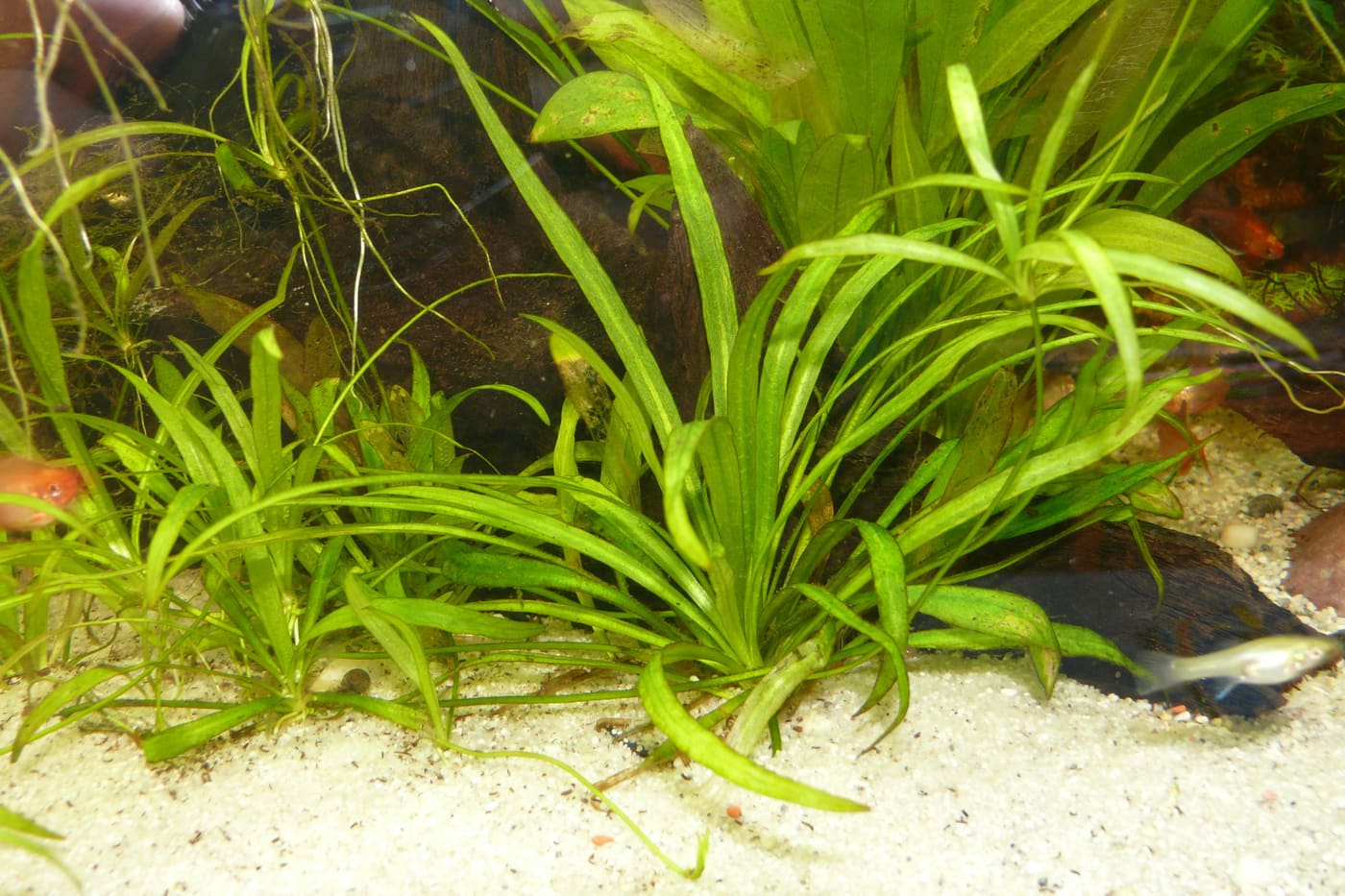
Helanthium bolivianum is one biological species wearing at least six shop labels. The upright grassy forms are 'Angustifolius' (long sold as Echinodorus angustifolius), the broader 'Latifolius' and 'Quadricostatus' (traded as Echinodorus magdalenensis or E. bolivianus var. magdalenensis) and the 'Xingu' variant; 'Vesuvius' is the corkscrew mutant of 'Angustifolius', selected by Eu Kwee Hwang at the Oriental Aquarium nursery in Singapore and shown at Interzoo 2006 by Stoffels International. Kew accepts every one of those Echinodorus names as a synonym of this single species, so the shelf is a naming mess rather than a row of different plants. Happy, it is a clump of upright, bright-green, slightly translucent blades 3-4 mm wide, 10-30 cm tall in the compact forms, throwing runners across the substrate and chaining into new rosettes fast enough to fill a midground in a couple of months; in 'Vesuvius' every leaf is wound into a tight spiral, and nothing else in the hobby twists like it. Size is the first thing the pot undersells. 'Vesuvius' settles at about 25 cm and reaches 40; 'Angustifolius' leaves run to 50 cm and sometimes past 60 in a deep tank, which is why Flowgrow files both of those forms under background planting and a Lithuanian retailer sells 'Vesuvius' outright as a galinis planas plant. Only the compact 'Quadricostatus', at 10-15 cm, is honestly a foreground plant. Buy the wrong form for the front row and you get a curtain, not a carpet. It almost always arrives emersed or from tissue culture, and the nursery leaves melt back after planting - that is a leaf turnover, not a death: slender submersed blades follow within weeks, and the Vesuvius corkscrew only ever forms under water, so a freshly planted pot looks nothing like the catalogue photo. How much light it wants is genuinely contested. Flowgrow rates the species and all four cultivar pages 'medium to high', and Interaquaristik and Florida Aquatic Nurseries agree; Aquasabi and Tropica's 'Vesuvius' data say medium, while Tropica rates its own 'Quadricostatus' low. We publish medium because that is where the independent database and the growers overlap, but the foreground ground-cover use Flowgrow lists is a high-light claim: at medium light expect a rosette, not a lawn. In shade it does not die - it grows less compact, a looser, lankier rosette, and the spiral itself is retained. Pale, washed-out leaves are the classic micronutrient deficiency sign; Tropica's wording is a shortage of micro-nutrients, and Flowgrow asks for 0.01-0.5 mg/l iron alongside the rest of the trace mix. In barren gravel it stalls, because it is a heavy root feeder; and above roughly pH 7.5 growth slows without CO2 injection, while below that it runs happily on none. The catalogue colour is honest: this is a green plant with no red forms. Whether the corkscrew is permanent is disputed, which is worth knowing before paying a premium for it. Aquasabi and EchiPedia both state the spiral curling is retained however the plant is grown; growers report otherwise, and a GWAPA thread describes 'Vesuvius' reverting to its straight-leaved form for no apparent reason, with one aquarist putting roughly a third of new growth in straight leaves. Emersed and in-vitro stock muddies it further, because that form carries shorter, broader, barely twisted and often almost straight leaves by default. So a straight-leaved plant sold as 'Vesuvius' may be mislabeled 'Angustifolius', may be emersed stock that has not converted yet, or may be a real reversion - give it a few weeks under water before deciding which. On the shop bench the straight forms are confused with Vallisneria (especially V. nana, which Flowgrow names outright) and Dwarf Sagittaria: Vallisneria leaves are blunt-tipped ribbons veined in parallel from base to tip, Sagittaria leaves are thick and fleshy with runners travelling under the substrate, while Helanthium blades taper to a point over a distinct midrib and its runners creep across the surface. Against its smaller sibling, the pygmy chain sword Helanthium tenellum, the numbers separate them cleanly: tenellum is a 5-10 cm turf of blades 1.5-2 mm wide, bolivianum a 10-30 cm clump of blades 3-4 mm wide - two to three times the height on roughly double the leaf width. The two are genuinely hard to tell apart only as emersed pots, where Flowgrow notes that 'Latifolius' emersed leaves resemble both H. tenellum and 'Angustifolius'.
Care
Strip the rock wool, plant rosettes a few centimetres apart in sand, fine gravel or aquasoil and push a root tab under them - this is a heavy root feeder, and bare gravel is the usual reason it sulks. Match the form to the position: compact 'Quadricostatus' suits the foreground, but 'Vesuvius' and especially 'Angustifolius' belong mid-tank or at the back, where 40-60 cm leaves are an asset instead of a screen. Give it a free, unshaded spot and expect the emersed nursery leaves to melt away before the true submersed ones appear over the following weeks. CO2 is optional below pH 7.5 but speeds the runners noticeably; thin and cut the chains to keep the group where you planted it.
Diet
Feeds mainly through its roots, so a nutrient-rich substrate or regular root tabs matter more than water-column dosing. Pale, washed-out new leaves mean a micronutrient shortage - that is Tropica's diagnosis for very light leaves - so dose a trace mix; Flowgrow's target range asks for 0.01-0.5 mg/l iron alongside it.
Also in these lists
Frequently asked questions
- What water parameters does a Bolivian Chain Sword need?
- Bolivian Chain Sword does best at 10–30 °C (50–86 °F), pH 5–7.5 and a general hardness of 0–20 °dGH.
- Where should Bolivian Chain Sword be placed in the aquarium?
- Bolivian Chain Sword works best in the midground and reaches around 50 cm.
- Is the Bolivian Chain Sword suitable for beginners?
- Yes — Bolivian Chain Sword is one of the easier species to keep and forgives typical first-tank mistakes, as long as the aquarium is cycled and maintained.
Sources
- Helanthium bolivianum - Bolivianische Zwergschwertpflanze - Flowgrow Wasserpflanzen-Datenbank
- Helanthium bolivianum 'Vesuvius' - Flowgrow Wasserpflanzen-Datenbank
- Helanthium bolivianum 'Angustifolius' - Flowgrow Wasserpflanzen-Datenbank
- Helanthium bolivianum 'latifolius' - Flowgrow Wasserpflanzen-Datenbank
- Helanthium bolivianum 'quadricostatus var. xinguensis' - Flowgrow Wasserpflanzen-Datenbank
- Helanthium bolivianum (Rusby) Lehtonen & Myllys | Plants of the World Online, Kew
- Helanthium bolivianum 'Quadricostatus' (068TC) - Tropica Aquarium Plants
- Helanthium bolivianum 'Vesuvius' | Aquasabi
- Helanthium bolivianum 'Vesuvius' TC (Tropica specs reproduced by Planted Aquaria)
- Echinodorus Vesuvius: An Oddball Sword Plant with a Twist - Aquarium Co-Op
- Korkenzieher-Schwertpflanze (Echinodorus Vesuvius) - Interaquaristik.de
- Echinodorus vesuvius - Greater Washington Aquatic Plant Association forum
- Helanthium bolivianum Vesuvius - EchiPedia
- Helanthium 'Vesuvius' - Florida Aquatic Nurseries
- Helanthium Vesuvius - aquauga.lt
- Helanthium bolivianum - Wikispecies